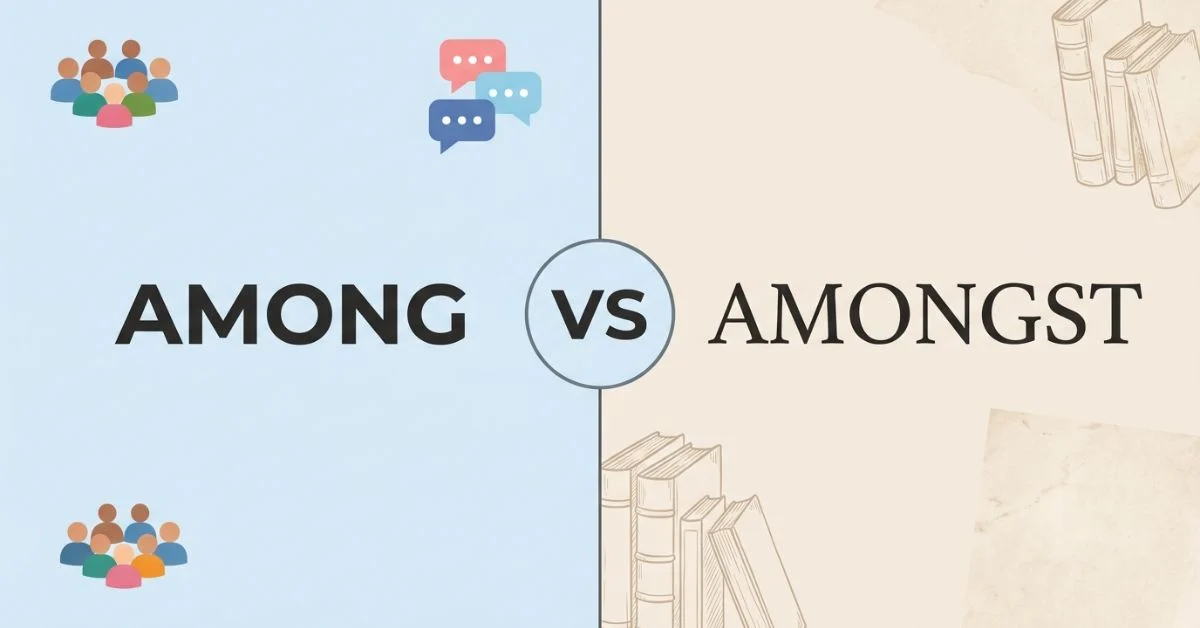
At first glance, “among” and “amongst” look like two different words with different meanings. But in reality, they often appear in the same situations, which makes many writers stop and think.
If you’re searching amongst or among, the confusion is completely understandable. Both words show up in books, articles, and even formal writing, making it hard to know which one is actually correct.
The truth is simple, but not obvious. These two forms come from the same root, yet their usage has changed over time. One is modern and widely used, while the other carries a more traditional tone.
In this guide, everything is explained in a clear and simple way, so choosing between them becomes easy and natural.
Quick Answer
Meaning
Both among and amongst mean:
- In the middle of a group
- Surrounded by people or things
- Part of something larger
Examples
- She was sitting among friends.
- He walked amongst the trees.
Final Answer
Among is the modern and preferred word.
Amongst is correct but sounds more formal or old-fashioned.
The Origin of Amongst or Among
History
The word among comes from Old English “gemang,” which means “in a group.” Over time, people added “-st” to form amongst, which was common in older styles of English.
Why Two Forms Exist
In earlier English, adding “-st” made words sound more formal or poetic. As language evolved, simpler forms became more popular.
Modern Usage
Today, among is widely used in everyday writing, while amongst is mostly used for style or in formal contexts.
British English vs American English Spelling
Usage Comparison
| Version | Preferred Usage |
|---|---|
| American English | Among |
| British English | Among (common), Amongst (formal) |
Key Insight
Both regions understand and accept both words, but among is more commonly used everywhere.
Which Spelling Should You Use?
Global Writing
Use among for clarity and simplicity.
American English
Always use among.
British English
Use among in most cases. Use amongst only for a formal or literary tone.
Writing Tip
For blogs, SEO, and general writing, among is the safest and best choice.
Common Mistakes with Amongst or Among
Using Them as Different Words
Both words have the same meaning. There is no difference in definition.
Overusing “Amongst”
Using “amongst” too often can make writing feel outdated.
Mixing Both in One Article
Stick to one version to keep your writing consistent and professional.
Amongst or Among Meaning (Detailed)
Usage in Grammar
Both words are prepositions used when talking about groups of three or more.
When to Use
- When referring to a group
- When something is shared
- When describing being surrounded
Examples
- The gifts were shared among the children.
- She felt relaxed amongst her colleagues.
Amongst or Among in Everyday Examples
The tasks were divided among the team.
News
The issue created discussion among experts.
Social Media
Feeling happy among friends today.
Formal Writing
The tradition continues amongst local communities.
Amongst or Among – Google Trends & Usage Data
Global Trends
Search data shows that among is used far more frequently worldwide.
Regional Insight
In the United States, almost everyone uses among. In the UK, both are used, but among is still more common.
Conclusion
Modern English strongly prefers among in most situations.
Comparison Table: Among vs Amongst
| Feature | Among | Amongst |
|---|---|---|
| Meaning | Same | Same |
| Style | Modern | Formal |
| Popularity | High | Lower |
| Recommended | Yes | Limited use |
FAQs
What is the difference between among and amongst?
There is no difference in meaning. The only difference is style. “Among” is modern, while “amongst” sounds more formal or traditional.
Is amongst outdated?
It is not completely outdated, but it is less common in modern writing and mostly used in formal or literary contexts.
Which is correct among or amongst?
Both are correct, but “among” is preferred in most situations.
Is amongst British English?
Yes, it appears more often in British English, especially in formal writing, but “among” is still more common.
Can I use among everywhere?
Yes, “among” works in all modern contexts and is the safest choice.
Should I avoid amongst completely?
No, but use it only when you want a formal or stylistic tone.
Conclusion
If you’ve been confused between amongst or among, the answer is simpler than it seems.
Both words have the same meaning and can be used in similar situations. They describe being part of a group or surrounded by multiple people or things.
The real difference comes down to style and modern usage. Among is the simpler, clearer, and more widely accepted form.
It works in almost every situation, from casual writing to professional content. On the other hand, amongst carries a more formal and slightly old-fashioned tone, which may not always fit modern writing.
For most purposes, especially blogging and SEO, among is the best choice. It keeps your writing clean, natural, and easy to understand.
Now you can confidently choose the right word and improve the clarity of your writing every time.