I once sent a message that said, “Your going to love this!”, and instantly realized something was wrong. That small mistake is one of the most common in English: confusing you’re or your.
Many people search this keyword because both words sound exactly the same.
They appear in everyday writing, texts, emails, and social media, and even a small error can change meaning or make writing look unprofessional.
So, how do you know which one to use?
This guide explains everything in a simple way. You’ll learn the quick difference, meanings, grammar rules, and real-life examples.
By the end, you’ll never mix up you’re or your again.
Quick Answer
Meaning
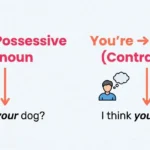
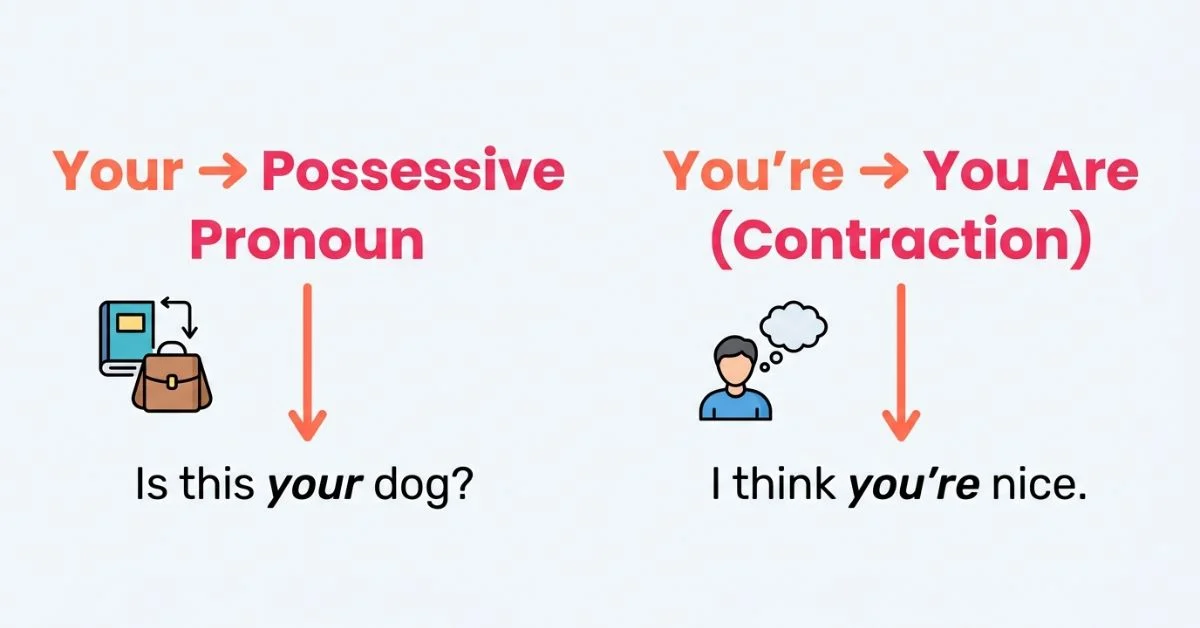
👉 Your shows ownership
👉 You’re means you are
- Your is a possessive pronoun
- You’re is a contraction
Examples
- Your phone is ringing.
- You’re going to love this.
✔️ Quick trick: Replace you’re with you are. If it makes sense, it’s correct.
The Origin of You’re or Your
Your
The word your comes from Old English and has always been used to show ownership or belonging.
You’re
The word you’re is a shortened form of you are. The apostrophe replaces the missing letter “a”.
👉 Example:
- You are → You’re
This explains why both words exist—they serve different grammar roles.
British English vs American English Spelling
Usage Comparison
There is no difference between British and American English for these words.
| Version | Your | You’re |
|---|---|---|
| American English | Standard | Standard |
| British English | Standard | Standard |
| Meaning | Same | Same |
👉 Both are used the same way worldwide.
Which Spelling Should You Use?
When to Use “Your”
Use your when showing ownership or possession.
👉 Example:
- Is this your book?
When to Use “You’re”
Use you’re when you mean you are.
👉 Example:
- You’re very kind.
✔️ Always apply the “you are” test to check correctness.
Common Mistakes with You’re or Your
Mistake 1
❌ Your going to win.
✔️ You’re going to win.
Mistake 2
❌ I like you’re style.
✔️ I like your style.
Mistake 3
Using the wrong word without checking meaning.
✔️ Fix: Always test with you are.
You’re or Your in Everyday Examples
- Your report looks great.
- You’re doing an excellent job.
News
- Your safety is important.
- You’re seeing major changes in the market.
Social Media
- Your post made my day 😊
- You’re so funny 😂
Formal Writing
Both are correct when used properly.
You’re or Your – Google Trends & Usage Data
Search trends show that both words are widely used across the world. However, most searches come from people trying to understand the difference between them.
There is no regional variation, which makes this a universal grammar confusion. Students, writers, and professionals all frequently search for this topic.
Comparison Table: You’re vs Your
| Feature | Your | You’re |
|---|---|---|
| Type | Possessive Pronoun | Contraction |
| Meaning | Shows ownership | Means “you are” |
| Example | Your car | You’re late |
| Usage | Objects | Actions/States |
FAQs
What is the difference between your and you’re?
The difference between your and you’re is simple. Your shows ownership, meaning something belongs to someone, while you’re is a contraction of “you are.” Understanding this basic rule helps avoid common grammar mistakes.
When should I use you’re?
You should use you’re whenever you can replace it with “you are” in a sentence. If the sentence still makes sense, then using you’re is correct.
Is your a possessive word?
Yes, your is a possessive pronoun. It is used to show that something belongs to the person you are speaking to.
Why do people confuse your and you’re?
People often confuse these words because they sound the same when spoken. These types of words are called homophones, which commonly lead to writing mistakes.
How can I remember the difference?
The easiest way to remember is by using the “you are” test. If replacing the word with “you are” works in the sentence, then you’re is correct. Otherwise, use your.
Is it a serious grammar mistake?
Yes, mixing up your and you’re can make your writing look careless, especially in professional or formal situations.
Can both be used in the same sentence?
Yes, both can be used in the same sentence correctly. For example: You’re responsible for your work.
Conclusion
If you’ve ever been confused between you’re or your, the solution is simple once you understand their roles. These two words may sound the same, but they have completely different meanings.
Your is used to show ownership, while you’re is just a shorter way of saying “you are.” This small difference can greatly improve the clarity and professionalism of your writing.
Mistakes are common, but they are easy to fix. Just remember the simple trick: replace you’re with “you are” and see if the sentence still works. If it does, you’ve used it correctly.
With this understanding, you can now write with confidence and avoid one of the most common grammar errors in English.