Ever typed yall or y’all and paused, unsure which one is actually correct? You’re not alone.
Writers, students, bloggers, and even social media users face this tiny but confusing grammar problem every day.
It often shows up in casual chats, captions, and emails, where yall or y’all seems interchangeable, but it’s not.
This small punctuation detail can change how professional or accurate your writing looks. If you’ve ever second-guessed yourself while typing it, this guide is made for you.
Let’s clear the confusion and make using yall or y’all simple and natural.
Quick Answer
Meaning
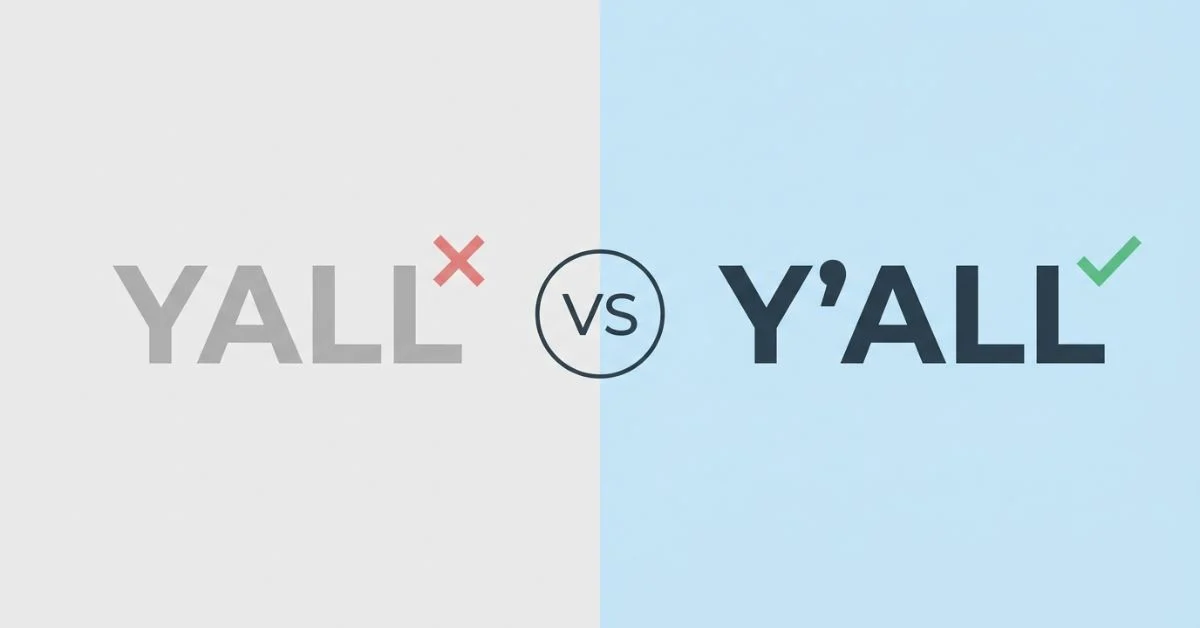
- Y’all is a contraction of “you all”
- Yall is not a correct standard spelling
Example
- Are y’all coming to the party? ✔️
- Are yall coming to the party? ❌
Final Answer
Always use y’all with an apostrophe.
The Origin of Yall or Y’all
History
The word y’all comes from Southern American English, where it developed as a natural way to say “you all.”
Why It Exists
English does not have a clear plural form of “you,” so y’all became a simple and natural solution.
Apostrophe Role
The apostrophe replaces the missing letters in “you all,” forming y’all.
British English vs American English Spelling
Usage Comparison
| Type | Usage |
|---|---|
| American English | y’all (common in speech & informal writing) |
| British English | rarely used, prefers “you all” |
Key Insight
- Y’all is strongly associated with American English
- Not commonly used in formal British English
Which Spelling Should You Use?
Correct Form
Use y’all in all informal writing.
Avoid This
Do not use yall without an apostrophe.
Writing Advice
- Informal writing → y’all is fine
- Formal writing → use “you all” instead
Common Mistakes with Yall or Y’all
Missing Apostrophe
Writing yall instead of y’all is the most common mistake.
Using It in Formal Writing
Avoid using y’all in academic or professional documents.
Overthinking Grammar
Some people think y’all is incorrect, but it is widely accepted in informal English.
Y’all Meaning (Detailed)
Basic Meaning
Y’all simply means:
- You all
- A group of people
Usage Context
- Talking to more than one person
- Casual conversations
- Friendly tone
Yall or Y’all in Everyday Examples
Email (Informal)
- Hope y’all are doing well.
Social Media
- What are y’all doing today?
Conversation
- Are y’all ready to go?
Formal Writing
- Incorrect: Dear y’all ❌
- Correct: Dear everyone ✔️
Yall or Y’all – Google Trends & Usage Data
Popularity
- Y’all is widely used in the United States
- Increasingly popular in online communication
Global Usage
- Common in American culture
- Less common in other English-speaking regions
Comparison Table: Yall vs Y’all
| Feature | Yall | Y’all |
|---|---|---|
| Correctness | ❌ Incorrect | ✅ Correct |
| Type | Misspelling | Contraction |
| Meaning | None | You all |
| Usage | Not recommended | Informal English |
FAQs
Is yall a real word?
No, yall without an apostrophe is not considered correct in standard English writing.
What does y’all mean?
Y’all means “you all” and is used to address a group of people.
Is y’all formal or informal?
Y’all is informal and mostly used in casual communication.
Why is there an apostrophe in y’all?
The apostrophe replaces the missing letters from “you all.”
Can I use y’all in professional writing?
It is better to avoid it and use “you all” or “everyone” instead.
Where is y’all commonly used?
It is most commonly used in Southern American English.
Conclusion
The difference between yall or y’all is simple but important. While both may sound the same in speech, only one is correct in writing.
Y’all is the proper form because it is a contraction of “you all,” and the apostrophe plays a key role in showing this. On the other hand, yall is just a misspelling and should be avoided in all types of writing.
This small punctuation mark can make a big difference in clarity and correctness. Whether you’re writing a message, a post, or a blog, using the right form shows attention to detail and proper understanding of English.
In short, always remember: if you mean “you all,” the correct form is y’all.

Eric White is a dedicated grammar enthusiast and content writer at Grammiffy, where he simplifies the rules of English for learners of all levels. With a clear, reader-first approach, Eric focuses on grammar fundamentals, common mistakes, sentence structure, and everyday language usage.