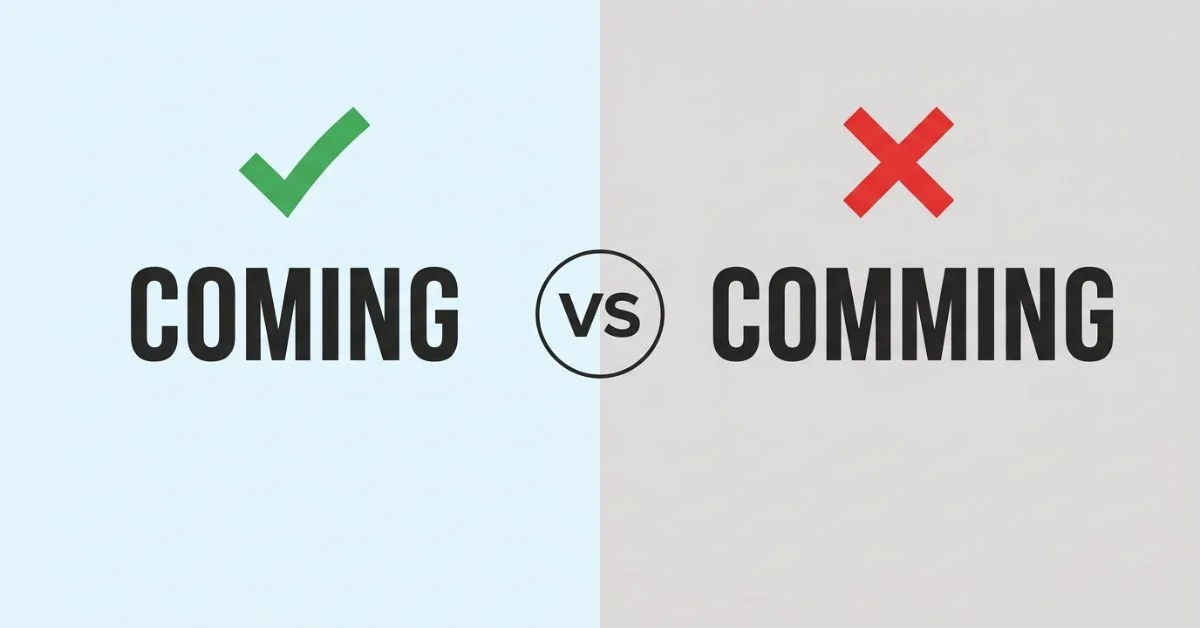
Ever typed “I am comming” and suddenly felt unsure if it looked right? That small doubt is something almost every English learner and writer faces at some point.
This confusion is very common among students, bloggers, content writers, and anyone learning English spelling rules.
The words comming and coming may sound the same, but only one of them is actually correct.
The mistake usually happens because of confusion around spelling rules, especially when adding “-ing” to verbs. Many people think they need to double the letter “m,” but that’s not always true.
In this guide, everything is explained in a simple and clear way. By the end, you’ll know the correct spelling, understand the rule behind it, and avoid this mistake in your writing forever.
Quick Answer
Meaning
- Coming = correct spelling, used as a verb form
- Comming = incorrect spelling
Examples
- She is coming home. ✅
- She is comming home. ❌
Final Answer
Always use coming in correct English.
The Origin of Comming or Coming
History
The word coming comes from the verb “come.”
Development
When forming the present participle:
- “come” + “-ing” = coming
Why the Difference Exists
English spelling rules do not require doubling the “m” in this case.
British English vs American English Spelling
Usage Comparison
| Version | Correct Spelling | Incorrect Spelling |
|---|---|---|
| British English | Coming | Comming |
| American English | Coming | Comming |
Key Insight
Both US and UK English agree:
👉 Coming is correct
👉 Comming is wrong
Which Spelling Should You Use?
In All Writing
Use coming in emails, essays, blogs, and messages.
Important Rule
There is no situation where comming is correct.
Easy Tip
- “Come” → drop “e” + “ing” = coming
Common Mistakes with Comming or Coming
Doubling the Letter “M”
Many learners think they must double the consonant, which is incorrect here.
Ignoring the Rule
Not all verbs follow the same pattern when adding “-ing.”
Typing Errors
Fast typing often leads to writing “comming” by mistake.
Comming or Coming Meaning (Detailed)
Coming Meaning
- Present participle of “come”
- Used in continuous tenses
- Shows movement toward something
Comming Meaning
- Not a real or accepted word
- Considered a spelling mistake
Comming or Coming in Everyday Examples
Conversation
- I am coming to meet you.
Workplace
- The manager is coming to the meeting.
Social Media
- Big news is coming soon!
Incorrect Example
- I am comming to meet you. ❌
Comming or Coming – Google Trends & Usage Data
Popularity
- Coming is widely used and searched
- Comming appears mostly as a spelling mistake
Insight
Search data clearly shows that coming is the correct and dominant form.
Comparison Table: Comming vs Coming
| Feature | Coming | Comming |
|---|---|---|
| Correctness | ✅ Correct | ❌ Incorrect |
| Usage | All contexts | None |
| Grammar | Standard | Error |
| Popularity | Very High | Very Low |
FAQs
What is the difference between comming and coming?
Coming is the correct spelling, while comming is a mistake.
Is comming a real word?
No, it is not accepted in standard English.
Why is coming spelled with one “m”?
Because the verb “come” does not follow the rule of doubling consonants before adding “-ing.”
When should I use coming?
Use it when forming continuous tenses or describing movement.
How can I remember the correct spelling?
Think: “come” → remove “e” → add “ing” → coming.
Is coming used in both US and UK English?
Yes, both use the same correct spelling.
Conclusion
The confusion between comming or coming is very common, but the solution is simple once you understand the rule. Only one of these forms is correct in standard English.
Coming is the correct spelling and is used in all types of writing, from casual messages to professional content. It follows a simple rule, drop the “e” from “come” and add “-ing.”
On the other hand, comming is just a spelling mistake. It does not follow English grammar rules and should be avoided in all situations.
By remembering this simple rule, you can avoid a very common error and improve the clarity and accuracy of your writing. Now you can use coming confidently without any doubt.
