You wake up early, check your calendar, and notice an important meeting scheduled for 12 PM.
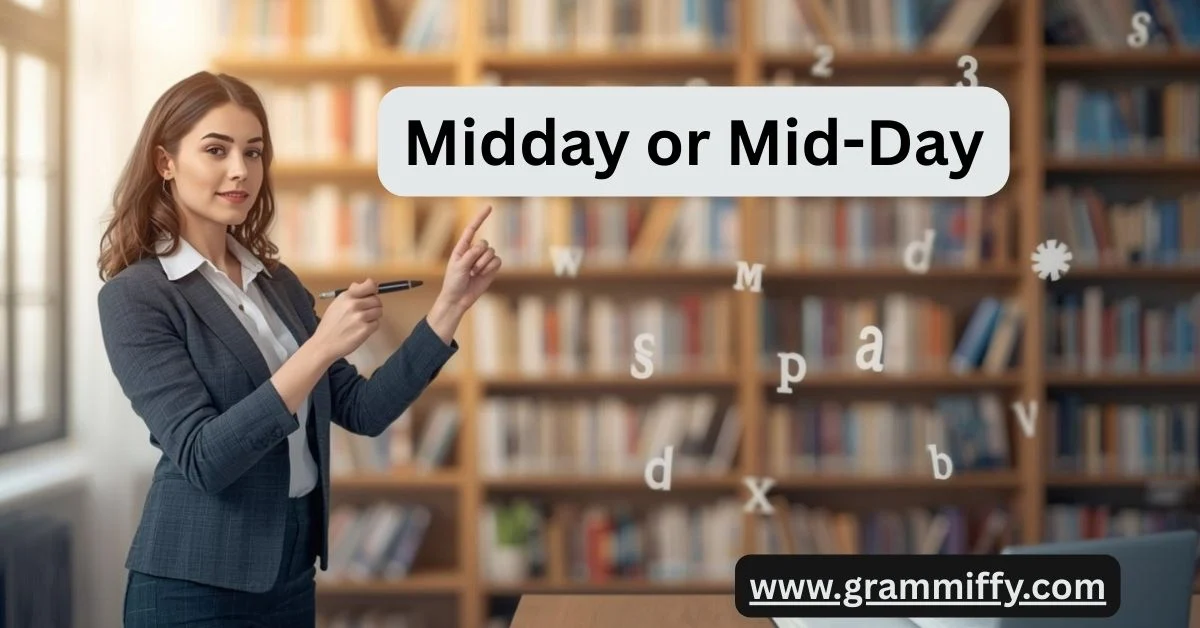
Later, while drafting an email reminder, you pause: “The meeting will start at midday or mid-day.” Which spelling is correct? Should it be one word or hyphenated?
This confusion is very common. Students, bloggers, journalists, and professionals often search for midday or mid-day because both forms appear online, in newspapers, and even in style guides.
One is considered standard in modern English, while the other is sometimes acceptable in older texts or specific style formats.
In this guide, we’ll cover everything about midday or mid-day: the correct meaning, synonyms, AP style, usage in IELTS writing, newspapers, UK English, and tips for using the term naturally in sentences.
By the end, you’ll confidently know when to write midday and when a hyphenated mid-day is acceptable.
Midday or Mid-Day – Quick Answer
- Midday → the most widely accepted modern spelling; refers to 12 PM or the middle of the day.
- Mid-Day → hyphenated form; occasionally used in older texts or informal writing but considered less standard today.
Examples:
- The train departs at midday.
- Lunch is served at mid-day in some restaurants.
✅ For most professional writing, emails, and formal contexts, midday is preferred.
Midday or Mid-Day Meaning
Both forms refer to the middle of the day, usually 12 PM, when the sun is at its highest point.
Midday is considered a noun or adverb, depending on the sentence:
- The sun shines brightest at midday. (noun)
- We will meet midday tomorrow. (adverb)
Mid-Day is a less common variant, usually seen in older publications or creative writing:
- The parade started at mid-day.
In everyday English, midday is now the standard and widely recognized form.
Midday or Mid-Day Synonym
If you want alternatives for midday or mid-day, you can use:
- Noon – very common, formal or informal
- Twelve o’clock – specific and precise
- High noon – literary or dramatic use
- Middle of the day – informal and descriptive
Examples:
- We’ll eat lunch at noon.
- The market closes at twelve o’clock.
- The duel took place at high noon.
- He usually takes a break in the middle of the day.
Midday or Mid-Day – AP Style
According to AP Stylebook, the correct form is:
✅ midday (one word, no hyphen)
AP Style favors clear, simple, and modern spelling. The hyphenated mid-day is discouraged in professional journalism.
Example:
- The event will start at midday. (AP-approved)
- ❌ The event will start at mid-day (not recommended)
Midday or Mid-Day – IELTS Writing Tips
IELTS test-takers often wonder whether midday or mid-day matters in formal writing. The answer is yes—midday is preferred.
- Use midday when describing time or schedules:
The class begins at midday, so students should arrive early. - Avoid hyphenated mid-day in essays, as it may be considered slightly outdated.
- Synonyms like noon are also acceptable for formal writing.
Midday or Mid-Day in Newspapers
Professional newspapers and media outlets almost always use midday.
- Example from modern news:
The press conference will begin at midday in the city hall. - Older newspaper editions may occasionally use mid-day, but modern editorial standards have shifted toward the single-word version.
Consistency matters—choose midday for clarity and professional tone.
Midday or Noon
Many writers confuse midday and noon. Here’s the difference:
- Noon = exactly 12 PM, precise and fixed
- Midday = approximately 12 PM, can include surrounding hours
Example:
- The meeting starts at noon sharp.
- We usually have lunch around midday.
Both are correct, but midday is slightly more flexible in everyday usage.
Mid Day Today – Common Usage
People often ask: “What time is mid day today?”
Correct usage:
- The conference will start midday today ✅
- Lunch is served midday today ✅
Avoid hyphenating unless following older style guides. Midday today is concise, clear, and standard in emails, schedules, and news updates.
Midday or Mid-Day in UK English
In the UK, both midday and mid-day have been used historically, but modern British English follows the same trend as American English:
- ✅ midday → standard in newspapers, emails, and professional writing
- ⚠️ mid-day → occasional literary or informal usage
Example:
- The Parliament session will resume at midday.
- In classic literature, you may find: “He departed at mid-day.”
Common Mistakes with Midday or Mid-Day
❌ Using mid-day in formal writing
✅ Stick with midday for clarity and modern style
❌ Confusing midday with early morning or afternoon
✅ Remember: midday ≈ 12 PM
Writing mid-day today inconsistently in the same document
Keep spelling consistent: midday today
Using synonyms incorrectly in formal texts
Replace with noon only when exact time matters
Midday or Mid-Day – Examples in Sentences
Workplace
- The report is due midday.
School
- Lunch break begins at midday every day.
Conversation
- I usually take a walk around midday.
News
- The press briefing will start midday.
Formal Writing
- Meetings are scheduled midday to accommodate all participants.
Side-by-Side Comparison Table
| Feature | Midday | Mid-Day |
|---|---|---|
| Modern usage | ✅ Yes | ⚠️ Rare |
| Newspapers | ✅ Yes | ⚠️ Older editions |
| AP Style | ✅ One word | ❌ Hyphenated |
| UK English | ✅ Standard | ⚠️ Occasional |
| Flexibility | Approx. 12 PM | Approx. 12 PM |
| Formal writing | ✅ Recommended | ❌ Not preferred |
| Informal / Literary | ✅ Acceptable | ✅ Sometimes |
FAQs
1. Is midday or mid-day correct in modern English?
✅ Midday is preferred; mid-day is rare and mostly outdated.
2. Can I use mid-day in newspapers?
Occasionally in older editions, but modern newspapers use midday.
3. Is midday the same as noon?
Mostly yes; noon = exact 12 PM, midday = roughly around 12 PM.
4. Which form should I use for IELTS writing?
Use midday for formal writing and clarity.
5. Does UK English differ?
Modern UK English follows the same trend: midday is standard.
6. Are midday and mid-day interchangeable?
Rarely in modern usage; prefer midday to avoid confusion.
7. Can I say “midday today”?
Yes, that’s correct and widely accepted.
Conclusion
The confusion between midday or mid-day is understandable, but modern English makes it simple: use midday as one word for professional writing, newspapers, emails, IELTS essays, and everyday sentences. Reserve mid-day for historical or creative contexts.
Remember: midday means the middle of the day, approximately 12 PM, and using the correct spelling ensures clarity, professionalism, and consistency.
Once you stick with midday, your writing will always look polished, clear, and correct.