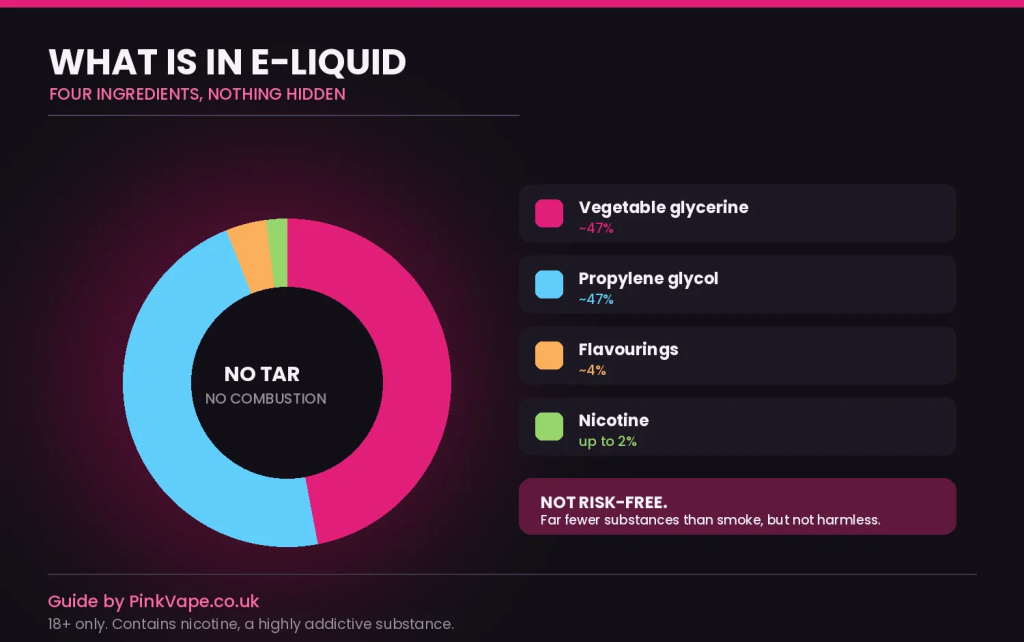
The list is shorter than most people expect and every item on it is declared. Here is what each ingredient is for and what the labelling tells you.
For a product people inhale several hundred times a day, e-liquid is unusually poorly understood by the people using it. Ask a room of vapers what is in the bottle and most will manage nicotine and flavouring, then run out.
The answer is genuinely simple. Four ingredients, all declared on the packaging, all required to be listed under UK regulations, and none of them exotic. Understanding what each does explains a great deal about why liquids behave differently in different devices — which is knowledge worth having whether or not the chemistry interests you.
This is a description of what is in the bottle rather than an assessment of health effects. On that question the position is straightforward and stated at the end: vaping is not risk-free, and it is not something anyone who does not already smoke should take up.
Four ingredients, all declared, none of them exotic.
Vegetable Glycerine
Usually the largest single component. A thick, faintly sweet, colourless liquid derived from plant oils, used widely in food, toothpaste, cosmetics and pharmaceuticals long before anybody vaped it.
In e-liquid it does one job: it produces vapour. Glycerine heated to the right temperature turns into a dense visible cloud, and the more of it a liquid contains, the more vapour you get.
- It is thick and syrupy, which is why high-VG liquids need larger coils with bigger wicks.
- It carries flavour less crisply than the alternative, so very high-VG liquids can taste slightly muted.
- It is mildly sweet in itself, which subtly affects the flavour of anything mixed with it.
A 50/50 liquid contains roughly half. A 70/30 shortfill for sub-ohm devices contains substantially more.
Propylene Glycol
The other half of the base. Thin, colourless and near-tasteless, used as a carrier in food flavourings, medicines and asthma inhalers among many other things.
Its jobs are carrying flavour and producing throat hit. Flavour compounds dissolve in it more readily than in glycerine, so a liquid with more propylene glycol tastes sharper and better defined. It also produces the slight catch at the back of the throat that smokers recognise.
- Being thin, it wicks quickly, which is why small pod coils need it.
- It has a mild drying effect in the mouth, which is why heavy vapers should drink more water than they think.
- A small proportion of people are sensitive to it and find high-PG liquids irritating. Moving to a higher-VG blend usually resolves it.
The ratio between these two is the number printed on every bottle, and matching it to your hardware is the single most useful thing to get right.
Flavourings
A small proportion of the total — typically a few per cent — but the reason anybody chooses one bottle over another.
These are food-grade flavour concentrates, the same category used in confectionery, drinks and baking. What differs in e-liquid is that some flavourings considered fine to eat are avoided for inhalation, and reputable manufacturers exclude them.
- Sweeteners are frequently added and are the main cause of coil residue. They caramelise onto the coil and shorten its life considerably.
- Cooling agents produce the sensation in menthol and ‘ice’ flavours. They are what make those profiles resistant to palate fatigue.
- Dark colourings tend to accompany dessert and cola profiles and contribute to the same residue problem.
This is why flavour choice has practical consequences beyond taste. A light citrus and a dark custard can differ by a factor of two in how long they let a coil survive.
Nicotine
The smallest component by volume and the reason most people are vaping at all. UK law caps it at 20mg per millilitre — two per cent — and caps nicotine-containing bottles at 10ml.
It comes in two forms, and the difference matters.
| Freebase | Nicotine salt | |
| Throat feel at high strength | Harsh | Smooth |
| Typical strengths | 3–6mg | 10–20mg |
| Absorption | Slower | Faster |
| Suits | Sub-ohm devices | Pod kits and MTL |
Salt is not a different drug. An acid is added, which lowers the pH and makes higher concentrations tolerable in the throat. That single change is what made small, low-powered devices viable for people leaving cigarettes, because it allowed a satisfying nicotine dose without the harshness that high-strength freebase produces.
What Is Not in It
Worth stating, because the absences explain the main argument for switching.
- No tobacco. Nicotine is extracted or synthesised; there is no leaf involved.
- No combustion. Nothing is burned, so there is no smoke, no ash and none of the products of burning.
- No tar. Tar is a product of combustion and cannot exist without it.
- No carbon monoxide, for the same reason.
That is the substance of the harm-reduction case: the overwhelming majority of smoking’s damage comes from burning tobacco, and vaping does not burn anything. It does not follow that vaping is harmless, and it is not — but the difference is real and it is why health bodies distinguish between the two.
Reading a Label
UK-compliant bottles carry everything you need. The VG/PG ratio, the nicotine strength, the volume, an ingredients list, batch and expiry information, and the required warnings. A missing ratio or a bottle above 10ml with nicotine in it means the product is not intended for this market. Listings at pinkvape.co.uk state the ratio and strength before you reach the checkout, which is where the decision actually gets made.
- Check the ratio matches your hardware — 50/50 for pod kits, 70/30 or thicker for sub-ohm.
- Check the strength suits both your habit and your device.
- Check the format — salt for pod kits, freebase for sub-ohm.
- Check the volume — 10ml with nicotine, or a larger shortfill at 0mg needing a shot added.
- Check it is from a UK-compliant source, since counterfeit liquid has unverified content.
Why the Ratio Matters More Than the Flavour
If there is one practical consequence of all the above, it is this. People choose e-liquid by flavour and treat the ratio as small print, when the ratio determines whether the liquid will work at all in their device.
| Your device | Buy this | What happens otherwise |
| Pod kit, coils 0.8 ohm and above | 50/50, nicotine salt, 10–20mg | High-VG cannot wick — dry hits and a burnt coil |
| Sub-ohm, coils below 0.6 ohm | 70/30 or thicker, freebase, 3mg | Thin liquid floods and leaks; salt over-delivers nicotine |
A perfect flavour in the wrong ratio is a bad purchase. An ordinary flavour in the right ratio works. Getting that round the right way saves more disappointment than any amount of careful flavour selection.
The strength consequence
The same logic applies to nicotine. Format and strength are tied to the device, not to preference — salts at 10 to 20mg for low-powered kit, freebase at 3mg for high-powered kit. Crossing them over produces either a vape that never satisfies or one that delivers far too much in a single draw.
Frequently Asked Questions
Is e-liquid the same as vape juice?
Yes — the terms are interchangeable, along with e-juice and vape liquid.
Why does some liquid taste sweeter?
Added sweeteners. They also shorten coil life, which is the trade.
What is a nicotine shot?
A small 10ml bottle of unflavoured nicotine base, added to a 0mg shortfill to bring it to a low strength.
Does e-liquid expire?
It degrades slowly rather than spoiling. Flavour fades and colour darkens; check the date on the bottle.
Why does the same flavour taste different in two devices?
Coil resistance, airflow and power all change what you taste. The liquid is the same; the conditions are not.
Is propylene glycol safe to inhale?
It is widely used in inhaled medicines, though that is not the same as saying vaping is without risk. Some people find it irritating and do better on higher-VG blends.
Are flavourings regulated?
Ingredients must be declared and certain substances are prohibited. Buying from UK-compliant sources is what makes that meaningful.
The Short Version
Two base liquids in roughly equal measure, a few per cent of flavouring, and up to two per cent nicotine. That is the whole list.
The ratio tells you which hardware it suits. The strength and format tell you whether it will satisfy you. Match those to your device and most e-liquid problems stop happening — and a Pink vape buy listing, like any compliant UK one, states all four before you reach the checkout.
Age restriction and health notice
This article describes the composition of e-liquid and is intended for adult smokers and vapers aged 18 or over. It is not medical advice and makes no health claims. Vaping is not risk-free and is not suitable for non-smokers, under-18s, or anyone who is pregnant or breastfeeding. E-liquid contains nicotine, which is highly addictive and toxic if swallowed, and should be stored securely out of reach of children and pets. If you are trying to stop smoking, your local NHS Stop Smoking Service offers free, evidence-based support.
