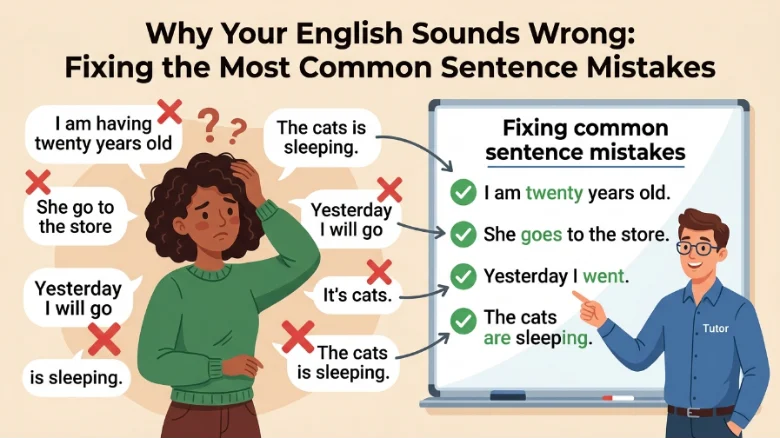
Many English learners reach a point where they can understand grammar rules, recognize vocabulary, and even form sentences—but something still feels off. Their English “sounds wrong,” even when it is technically understandable.
This is a very common problem in 2026, especially with the rise of AI tools that correct grammar but do not always teach natural sentence structure or fluency. The issue is not usually vocabulary. It is sentence construction, word order, and natural usage patterns.
In this guide, you will learn why your English may sound unnatural and how to fix the most common sentence mistakes step by step.
While language learning focuses on clarity and structure, real-world services also depend on precision and correct execution. For example, homeowners rely on professional providers offering ac maintenance houston tx to ensure systems run efficiently and avoid breakdowns. When unexpected issues occur, fast solutions like ac repair houston tx become essential for restoring comfort and proper function.
Why Your English Sounds Wrong (Even If It Is Grammatically Correct)
English is not just about rules. It is about patterns.
A sentence can be grammatically correct but still sound unnatural if it does not follow how native speakers naturally structure ideas.
For example:
- ❌ I very like this movie
- ✔ I like this movie very much
Both communicate the idea, but only the second sounds natural.
The main reasons English sounds “wrong” include:
- Incorrect word order
- Direct translation from native language
- Overuse of literal grammar rules
- Missing natural expressions and collocations
- Weak sentence rhythm
Fixing these issues improves clarity, fluency, and confidence.
1. Incorrect Word Order
Word order is one of the most important parts of English sentence structure. Unlike many languages, English has a strict pattern:
Subject + Verb + Object
Common mistake:
- ❌ I to the store go
- ❌ Yesterday I a movie watched
Correct:
- ✔ I go to the store
- ✔ I watched a movie yesterday
Why it matters:
Even if words are correct, wrong order makes sentences sound broken or confusing.
Fix:
Always structure your sentence in this order:
- Who is doing it? (Subject)
- What are they doing? (Verb)
- What is receiving the action? (Object)
2. Direct Translation from Native Language
Many learners translate sentences word-for-word from their native language. This is one of the biggest reasons English sounds unnatural.
Example:
- ❌ I am having 20 years
- ✔ I am 20 years old
Another example:
- ❌ She is very much beautiful
- ✔ She is very beautiful
Fix:
Instead of translating, learn full English phrases:
- “I am 20 years old”
- “I feel hungry”
- “I’m interested in…”
3. Wrong Use of “Very,” “Much,” and “Too”
Modifiers are often overused or used incorrectly.
Common mistakes:
- ❌ She is very much smart
- ❌ I am much happy
Correct:
- ✔ She is very smart
- ✔ I am very happy
Fix:
- Use “very” for most adjectives
- Use “much” mainly with comparatives or negatives
- Avoid combining “very much” unless necessary
4. Missing or Incorrect Articles (a, an, the)
Articles are one of the hardest parts of English for learners.
Common mistakes:
- ❌ I saw elephant
- ❌ She is engineer
Correct:
- ✔ I saw an elephant
- ✔ She is an engineer
Fix:
- Use “a/an” for general nouns
- Use “the” for specific nouns
5. Overusing Simple Sentence Structures
Many learners repeat simple sentences like:
- I go to school
- I eat food
- I like music
Improved versions:
- ✔ I go to school every morning to attend my classes
- ✔ I enjoy eating different types of food
- ✔ I really like listening to music in my free time
Fix:
Add details such as time, reason, and description.
6. Wrong Prepositions
Common errors:
- ❌ Married with him
- ❌ Good in English
- ❌ Listen music
Correct:
- ✔ Married to him
- ✔ Good at English
- ✔ Listen to music
7. Incorrect Verb Tenses
Mistakes:
- ❌ I go yesterday
- ❌ She is finished her work
Correct:
- ✔ I went yesterday
- ✔ She has finished her work
8. Using “Me and Him” Instead of “He and I”
Incorrect:
- ❌ Me and him went to the store
Correct:
- ✔ He and I went to the store
9. Redundant Expressions
Examples:
- ❌ Free gift
- ❌ End result
- ❌ Future plans
Correct:
- ✔ Gift
- ✔ Result
- ✔ Plans
10. Wrong Use of “I am agree”
Incorrect:
- ❌ I am agree
Correct:
- ✔ I agree
11. How to Make Your English Sound Natural
1. Learn phrases, not just words
2. Read natural English daily
3. Practice rewriting sentences
4. Listen to native speakers
Final Thoughts
Your English sounds wrong not because you lack knowledge, but because sentence patterns and natural expressions are missing.
The key to improvement is not memorizing rules—it is training your brain to think in English structures.
Once you understand word order, natural expressions, and common mistake patterns, your English becomes clearer, smoother, and more confident.
Remember:
Good English is not just correct English—it is natural English.
