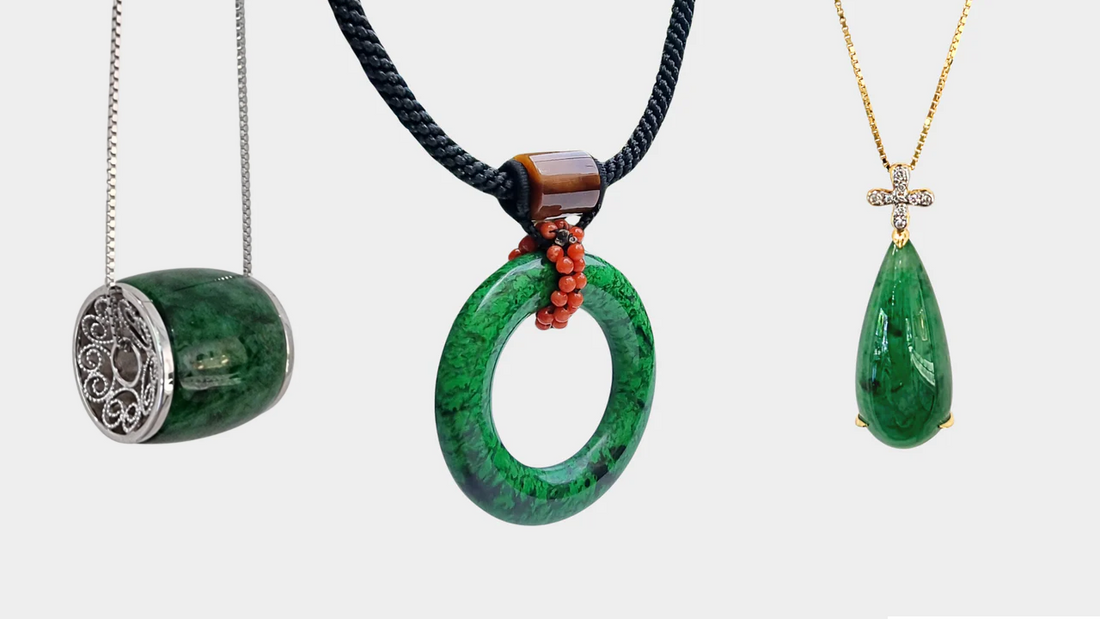
Buying jade online is a little like meeting someone through a photograph. The first impression may be beautiful, but you still need to know what is behind the image. A jadeite pendant necklace can look elegant on a screen, yet the real value depends on details that are easy to miss: the material, treatment status, certificate, color accuracy, pendant size, chain quality, carving, polish, and the honesty of the seller.
That is why online jade shopping should not be rushed. A pendant necklace is more than a small stone on a chain. It may sit close to the heart, carry a blessing, become a daily piece, or be given as a meaningful gift. If the necklace is meant to last, the buying process should feel clear, careful, and confident.
Before clicking “buy,” here is what to check.
1. Confirm That the Material Is Truly Jadeite
The word “jade” is often used loosely online. Sometimes it refers to jadeite. Sometimes it refers to nephrite. Sometimes it is used in an even less precise way for green stones that are not true jade at all.
This matters because jadeite and nephrite are different materials. Both can be genuine jade, but jadeite is especially valued in fine jade jewelry because of its rich color range, translucency, texture, and connection with traditional high-quality jadeite jewelry.
A trustworthy product page should clearly state what the pendant is made from. Look for descriptions such as jadeite, natural jadeite, untreated jadeite, or Type A jadeite. If the listing only says “jade necklace,” “green jade,” or “natural stone,” that is not enough information for a confident purchase.
A serious seller should not make the buyer guess the material.
2. Make Sure It Is Natural Untreated Type A Jadeite
If you are buying jadeite, one of the most important terms to understand is Type A.
Type A jadeite means natural jadeite that has not been chemically treated with acid bleaching, polymer filling, or artificial dyeing. It may be carved, polished, and finished, but the jadeite itself has not been chemically enhanced in the way treated jade has.
This is important because treated jadeite can still look attractive online. Dyed jadeite may appear vivid. Filled jadeite may appear cleaner than it really is. Strong lighting and photo editing can make treated pieces look even more convincing.
For a meaningful pendant necklace, treatment status matters. A pendant worn as a symbol of protection, peace, good fortune, or personal memory should be made from material that is honestly represented.
Avoid listings that only say “beautiful jade,” “lucky jade,” or “natural style” without explaining whether the piece is untreated. Pretty words cannot replace clear material information.
3. Check the Certificate Carefully
A certificate is especially important when buying jadeite online because you cannot inspect the pendant in person. You cannot hold it under natural light, look through the stone, or examine its surface closely with your own eyes.
A reliable certificate helps confirm what the pendant is. It should identify the material, show the testing institution, include a certificate number, and provide information about treatment status. When available, the certificate should also include measurements, weight, or product details that help connect it to the actual pendant.
Do not only check whether a certificate exists. Check whether it makes sense.
Does the certificate match the pendant being sold?
Is the number visible?
Is the material description clear?
Can the report be verified if the testing institution provides verification?
Do the dimensions or weight match the product listing?
A certificate should make the purchase feel clearer, not more confusing.
4. Look Beyond the First Product Photo
The first image is designed to catch your attention. It may be beautiful, but it should not be the only image you use to judge the necklace.
Jadeite can look very different under different lighting. Strong studio light may make the pendant appear greener, brighter, or more translucent. Natural daylight often gives a better sense of how the piece may look in everyday wear. Indoor lighting can change the tone again.
Look for multiple photos. Ideally, the listing should show the front, back, side, close-up details, chain connection, and a worn or scale reference image. A video is even better because it shows how the jadeite behaves when it moves.
Be careful with photos that look overly saturated or unusually smooth. If the green looks almost electric, the background is extremely white, and there are no natural light images, ask more questions.
A good seller should not depend on one perfect angle.
5. Evaluate the Color Realistically
Color is often the reason people fall in love with jadeite. But color should be judged carefully.
Green jadeite is the classic choice. It feels natural, balanced, and recognizable. Icy or white jadeite feels clean, modern, and understated. Lavender jadeite feels soft and distinctive. Yellow or honey jadeite feels warm and earthy. Mixed-color jadeite can feel especially personal because the natural pattern makes each pendant different.
When evaluating color online, ask whether it looks natural. Does the color seem to blend into the stone, or does it look like it sits on the surface? Does the pendant look similar across different photos, or does the color change dramatically from image to image? Is the price realistic for the color quality being shown?
Very bright color at a surprisingly low price should be checked carefully. Natural jadeite can be vivid and beautiful, but color should always be considered together with certificate, texture, transparency, and seller transparency.
The right color should not only look good on a screen. It should feel wearable in real life.
6. Study Texture and Transparency
A jadeite pendant’s beauty is not only in its color. Texture and transparency can completely change how refined the piece feels.
Fine-textured jadeite often looks smoother and softer. It may have a calm internal glow rather than a flat surface appearance. Coarser texture may look more grainy or cloudy, which can affect both appearance and price.
Transparency also matters. Highly translucent jadeite may feel icy and delicate. Semi-translucent jadeite often feels gentle and wearable. More opaque jadeite can feel grounded and traditional.
Do not confuse lighting with quality. A pendant may look bright because of strong light, not because it has excellent transparency. Look for close-up images and videos in normal lighting to understand the real texture.
Natural jadeite may include cotton-like areas, color roots, clouds, internal lines, or soft variations. These are not always defects. However, visible cracks, chips, or structural damage should be taken seriously.
A natural pendant does not need to be flawless, but its condition should be honestly shown.
7. Check the Pendant Shape and Meaning
A jadeite pendant necklace often carries symbolism. That is one reason people choose jade instead of ordinary jewelry.
A Buddha pendant may suggest peace, joy, tolerance, and a relaxed heart. A Guan Yin pendant often represents compassion, protection, and blessing. A Pixiu pendant is connected with wealth and guarding energy. A Ping An Kou pendant symbolizes safety, completeness, and smooth life. A dragon pendant can represent strength, confidence, and good fortune. A leaf pendant may suggest growth, hope, and new beginnings. A simple cabochon pendant can feel elegant, minimal, and easy to wear every day.
The pendant shape should match the wearer or the occasion. If you are buying for yourself, choose a symbol that feels connected to your own intention. If you are buying as a gift, think about whether the meaning suits the recipient.
Do not choose the most complicated carving simply because it looks impressive. Meaning should feel natural, not forced.
8. Inspect the Carving and Finish
Carving quality matters because jadeite is not only a material. It is also a crafted object.
A good carving should feel balanced. The lines should be clear, the shape should suit the stone, and the design should not look rushed. The pendant should have a sense of proportion, especially if it includes symbolic details such as a face, animal, leaf, or circular form.
The back of the pendant matters too. Many buyers focus only on the front, but the back can show whether the piece was finished with care. It should be smooth, comfortable, and not carelessly rough.
Edges should not look sharp or uneven. The polish should feel soft and refined, not plastic-like or dull. Good jadeite polish gives the stone a gentle luster. It should not look artificially glossy.
A pendant worn near the skin should feel pleasant from every side.
9. Review the Bail, Hole, Setting, and Chain
A pendant necklace is not only the jade. The connection system matters.
Check how the pendant attaches to the chain. Is there a bail? A drilled hole? A metal setting? A cord loop? The connection should look secure and appropriate for the pendant’s weight.
If the necklace includes metal, the product page should explain the material. Is it sterling silver, gold vermeil, solid gold, stainless steel, plated alloy, or another material? This affects durability, skin comfort, color matching, and long-term wear.
The chain should not feel like an afterthought. A weak chain can make even a beautiful pendant feel less reliable. A poorly made bail or thin connector can increase the risk of loss.
Also check the chain length. A 16–18 inch chain usually sits closer to the collarbone and feels delicate. A 20 inch chain is often more versatile for everyday wear. A 22–24 inch chain can suit larger pendants or relaxed styling.
A jadeite pendant deserves a chain that supports it properly.
10. Check Pendant Size and Weight
Product photos can be misleading because pendants are often shown close-up. A piece that looks large on screen may be small in person. A pendant that appears delicate may actually be heavier than expected.
Always check the measurements. Look for height, width, thickness, and weight if available. A worn photo or scale comparison can help you imagine the real size.
Small pendants are usually easier for daily wear. They work well with simple outfits and are often comfortable for first-time jade buyers. Medium pendants offer more presence while still remaining practical. Large pendants can feel powerful and symbolic, but they may not suit everyone’s lifestyle.
Weight is important too. A heavy pendant may pull on the chain or feel uncomfortable after long wear. If you want a necklace for daily use, comfort should come before drama.
A pendant should not only look good in a box. It should feel right on the body.
11. Compare Price With What Is Actually Included
Jadeite prices can vary widely. Color, texture, transparency, size, carving, certificate, treatment status, and metal components all affect value.
A practical buyer does not ask only, “Is this cheap or expensive?” A better question is, “What am I paying for?”
Is the jadeite natural and untreated?
Is there a certificate?
Is the color rare or common?
Is the texture fine or coarse?
Is the pendant hand-carved or simply shaped?
Is the chain made from quality material?
Are the photos and details transparent?
If a pendant looks vivid, clean, highly translucent, and unusually inexpensive, be careful. There may be missing information about treatment, material, certificate, or photo accuracy.
At the same time, the most expensive pendant is not always the best choice for you. A well-certified, wearable, meaningful piece that suits your style may be a better purchase than a more expensive pendant you rarely wear.
Good value comes from the match between quality, trust, and use.
12. Check the Seller’s Transparency
The seller is part of the product experience. A beautiful pendant from an unclear seller can still become a risky purchase.
A strong product page should provide clear material information, treatment status, certificate details, pendant measurements, chain material, chain length, photos, natural variation notes, and care guidance.
The return or exchange policy also matters. Online jade buying involves color perception, size expectation, and personal preference. Even when the product is accurately described, the buyer may need support.
Customer service should be able to answer specific questions. If you ask about certificate, chain material, pendant size, natural inclusions, or color difference, the answer should be clear and useful.
A trustworthy jade seller does not pressure buyers to ignore details. It helps buyers understand them.
Common Mistakes to Avoid
The first mistake is buying from the main photo alone. One beautiful image cannot show the full truth of a pendant necklace.
The second mistake is ignoring treatment status. If the listing does not clearly mention natural untreated jadeite or Type A jadeite, ask before buying.
The third mistake is forgetting about the chain. A pendant may be genuine and beautiful, but the necklace can still feel disappointing if the chain is weak, uncomfortable, or poorly matched.
The fourth mistake is choosing a pendant that is too large for daily wear. Bigger does not always mean better. Wearability matters.
The fifth mistake is treating all jade pendants as the same. Material, certificate, carving, polish, size, symbolism, and seller transparency can make two similar-looking necklaces very different.
A careful buyer avoids these mistakes by slowing down.
A Practical Online Buying Checklist
Before buying, check the following:
- Is the pendant clearly identified as jadeite?
- Is it natural untreated Type A jadeite?
- Is a reliable certificate included?
- Does the certificate match the pendant?
- Are there photos in realistic lighting?
- Is there a video or close-up image?
- Does the color look natural and wearable?
- Are texture and transparency shown clearly?
- Are natural features or flaws disclosed?
- Does the pendant shape carry a suitable meaning?
- Is the carving clean and balanced?
- Is the polish smooth and refined?
- Is the bail, hole, or setting secure?
- Is the chain material stated clearly?
- Is the chain length suitable?
- Are the pendant size and weight listed?
- Is the price realistic for what is offered?
- Is the seller transparent and responsive?
- Is the return policy clear?
- Would you still want this piece after the first visual excitement fades?
This checklist helps turn an emotional purchase into an informed one.
Buy the Pendant You Understand
A jadeite pendant necklace should be chosen with both feeling and clarity. It is natural to fall in love with a color, shape, or symbol, but the details behind the pendant matter just as much.
The best online purchase is not simply the piece that looks beautiful first. It is the piece you understand: what it is made from, whether it is untreated, how it is certified, what the symbol means, how large it is, how the chain is made, and whether the seller presents it honestly.
Jadeite is quiet jewelry, but it deserves careful attention. A pendant worn close to the heart should feel trustworthy, comfortable, and meaningful.
For buyers who want natural untreated jadeite, NGTC certification, thoughtful craftsmanship, and pendant designs suitable for daily wear or meaningful gifting, BMjade jadeite pendants offer a clear and reliable place to begin.
