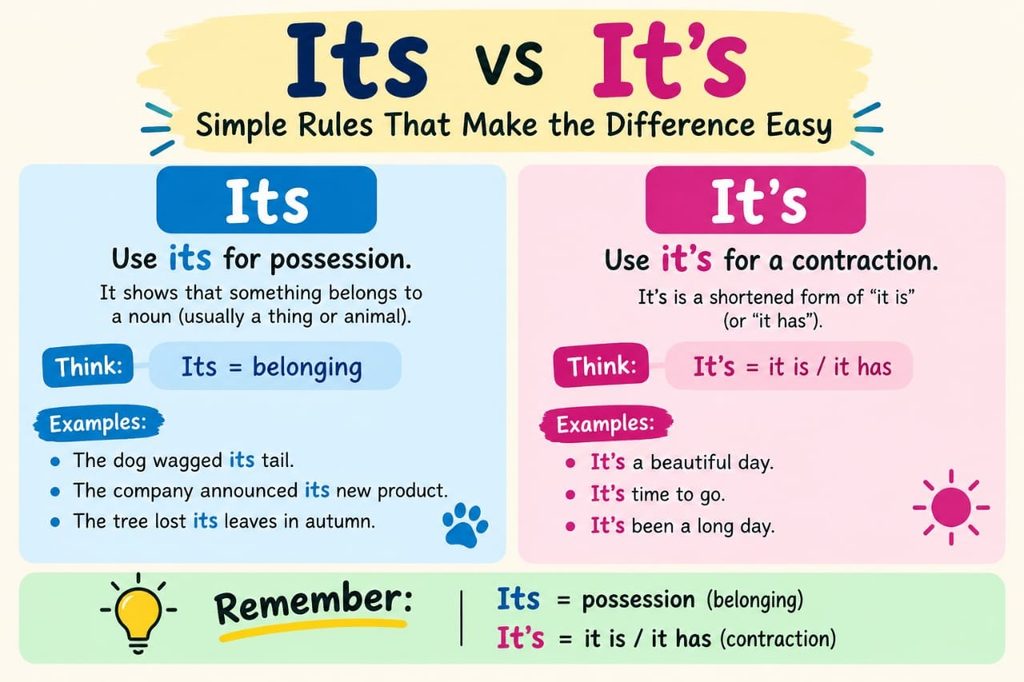
Its and it’s are two of the most commonly confused words in English. They look almost identical, but they have different meanings and serve different purposes in a sentence. The good news is that once you understand one simple rule, choosing between them becomes much easier –primoplay.
The difference between its and it’s comes down to possession and contraction. Its shows that something belongs to or is connected with something else, while it’s is a shortened form of either it is or it has.
Although this seems simple, the mistake appears often in emails, essays, social media posts, business writing, and everyday communication. Learning how to recognize the difference can help make your writing clearer and more professional-primo gaming 88.
Its vs It’s: What Is the Difference?
The easiest way to remember the difference is this:
Its = shows possession.
It’s = means it is or it has.
For example:
- The dog wagged its tail.
- It’s raining outside.
- The company changed its policy.
- It’s been a long day.
In the first and third examples, its shows ownership or association. In the second and fourth examples, it’s can be expanded into “it is” or “it has.”
This simple substitution test works in many situations.
If you can replace it’s with it is or it has, then it’s is correct. If that replacement does not make sense, you probably need its.
What Does “Its” Mean?
Its is a possessive word. It tells the reader that something belongs to, is associated with, or relates to an animal, object, organization, or other non-human subject.
For example:
- The company updated its website.
- The computer lost its connection.
- The bird spread its wings.
- The house has its own history.
- The restaurant changed its menu.
In each sentence, its connects the subject with something related to it.
“The bird spread its wings” means the wings belong to the bird.
“The restaurant changed its menu” means the menu is associated with the restaurant.
Examples of “Its” in Sentences
Here are more examples:
- The cat cleaned its paws.
- The car needs its tires replaced.
- The school announced its new schedule.
- The tree lost its leaves.
- The phone reached its storage limit.
- The business is known for its customer service.
Notice that its does not contain an apostrophe. This is one of the most important details to remember.
What Does “It’s” Mean?
It’s is a contraction. A contraction combines two words and replaces one or more letters with an apostrophe.
In this case, it’s can mean:
- it is
- it has
For example:
It’s cold today.
→ It is cold today.
It’s been a busy week.
→ It has been a busy week.
The apostrophe in it’s is important because it signals the missing letters from the original words.
“It’s” as “It Is”
When it’s means it is, it can describe something, identify something, or introduce information.
Examples include:
- It’s a beautiful morning.
- It’s difficult to explain.
- It’s important to practice.
- It’s the best option available.
- It’s getting late.
- It’s easy once you understand the rule.
Try expanding each sentence:
“It’s a beautiful morning” becomes “It is a beautiful morning.”
“It’s getting late” becomes “It is getting late.”
The sentence still works, so it’s is correct.
“It’s” as “It Has”
It’s can also mean it has, especially when followed by a past participle.
For example:
- It’s been a long journey.
- It’s already started.
- It’s changed since last year.
- It’s become much easier.
- It’s never happened before.
Expand one of these sentences:
It’s been a long journey.
→ It has been a long journey.
Since the expanded version makes sense, it’s is correct.
The Simple “It Is” Test
One of the fastest ways to decide whether you need its or it’s is to use the “it is” test.
Whenever you are unsure, replace it’s with it is.
For example:
The dog hurt it’s leg.
Replace “it’s” with “it is”:
The dog hurt it is leg.
That does not make sense. Therefore, the correct sentence is:
The dog hurt its leg.
Now consider:
It’s time to leave.
Replace “it’s” with “it is”:
It is time to leave.
That works, so it’s is correct.
You can also test it has in sentences where “it is” does not fit.
For example:
It’s changed a lot.
“It is changed a lot” does not work naturally.
But:
It has changed a lot.
That works, which means it’s is correct.
Common Its vs It’s Mistakes
Because the two forms look so similar, certain mistakes appear again and again.
Mistake 1: Using “It’s” to Show Possession
Incorrect:
The company updated it’s logo.
Correct:
The company updated its logo.
Why? The logo belongs to or is associated with the company. Therefore, the possessive its is needed.
Mistake 2: Leaving Out the Apostrophe in “It’s”
Incorrect:
Its important to check your work.
Correct:
It’s important to check your work.
Why? The sentence means:
It is important to check your work.
Therefore, the contraction it’s is correct.
Mistake 3: Assuming Every Apostrophe Shows Possession
Apostrophes are often used to show possession, such as in “Sarah’s book” or “the company’s office.” This can make it’s especially confusing.
However, it’s is an exception. Its apostrophe does not show possession. It indicates a contraction of it is or it has.
That is why:
The dog wagged its tail.
is correct, while:
The dog wagged it’s tail.
is incorrect.
Why Is “Its” Possessive Without an Apostrophe?
This question confuses many English learners because possessive nouns often use apostrophes.
For example:
- The boy’s backpack
- The teacher’s desk
- The company’s policy
So why is it its instead of it’s?
The answer is that its works like other possessive pronouns, such as:
- my
- your
- his
- her
- our
- their
- its
These possessive forms do not normally use apostrophes.
Compare:
- The company changed its policy.
- The company changed their policy.
In both cases, the possessive word does not need an apostrophe.
Understanding its as a possessive form rather than a possessive noun can make the rule easier to remember.
Its vs It’s in Professional Writing
Choosing the correct form is particularly important in professional communication. A small grammar mistake can distract readers or make otherwise polished writing appear rushed.
Consider these examples:
Incorrect:
The business should improve it’s customer support.
Correct:
The business should improve its customer support.
Or:
Incorrect:
Its important to respond quickly to customers.
Correct:
It’s important to respond quickly to customers.
These errors may seem minor, but consistent grammar helps establish credibility in emails, reports, website copy, proposals, and other professional documents.
Its vs It’s in Everyday Writing
The same rule applies to casual communication.
Examples include:
Correct:
- It’s almost time to go.
- The phone lost its signal.
- It’s been a great experience.
- The dog is chasing its ball.
- It’s not working properly.
The goal is not to memorize hundreds of examples. Instead, focus on what the word is doing in the sentence.
Ask yourself:
Am I showing possession?
Use its.
Can I replace the word with “it is” or “it has”?
Use it’s.
A Quick Comparison Table
| Word | Meaning | Example |
| Its | Shows possession or association | The company updated its website. |
| It’s | Means “it is” | It’s ready to launch. |
| It’s | Means “it has” | It’s been updated. |
This quick comparison can make the distinction easier to remember when proofreading.
A Simple Trick to Never Forget the Difference
When you see it’s, mentally expand it.
Ask:
Does “it is” work?
Or:
Does “it has” work?
If yes, keep it’s.
If neither works and you are talking about something belonging to or being connected with something, use its.
For example:
The company updated it’s website.
Try “it is”:
“The company updated it is website.”
That clearly fails.
Therefore:
The company updated its website.
Another example:
It’s ready now.
Try “it is”:
It is ready now.
That works.
Therefore, it’s is correct.
Why This Small Difference Matters
Grammar rules are not only about avoiding mistakes. They also help readers understand your meaning quickly.
When words look similar but have different functions, using the correct form removes confusion and makes sentences easier to read.
The difference between its and it’s may involve only one small apostrophe, but that apostrophe changes the meaning of the word.
Compare:
The machine lost its power.
with:
It’s lost power.
The first sentence uses its to show that the power belongs to or relates to the machine.
The second sentence means it has lost power.
The difference is subtle visually, but grammatically and logically, the words are doing completely different jobs.
Frequently Asked Questions About Its vs It’s
Is “its” always possessive?
Yes. Its is the possessive form used to show that something belongs to or is associated with an animal, object, organization, or other non-human subject.
Is “it’s” always a contraction?
Yes. It’s is a contraction of either it is or it has.
Can “it’s” ever show possession?
No. When you need the possessive form, use its without an apostrophe.
What is the easiest way to remember its vs it’s?
Use the substitution test. Replace it’s with it is or it has. If the sentence still makes sense, it’s is correct. Otherwise, use its when you are showing possession.
Which is correct: “The dog licked it’s paw” or “The dog licked its paw”?
The correct sentence is “The dog licked its paw.” The paw belongs to the dog, so the possessive its is required.
Which is correct: “Its important” or “It’s important”?
The correct form is “It’s important.” The sentence means “It is important.”
Final Thoughts
The difference between its and it’s becomes easy once you focus on their roles rather than how similar they look.
Remember the basic rule:
Its = possession.
It’s = it is or it has.
Whenever you are unsure, use the substitution test. Replace it’s with it is or it has. If the sentence works, you have your answer. If you are describing something that belongs to or is connected with something, choose its.
With a little practice, this common grammar confusion can become one of the easiest mistakes to avoid. Whether you are writing an email, an article, a school assignment, or a casual message, using its and it’s correctly will make your writing clearer, more polished, and easier to understand.
