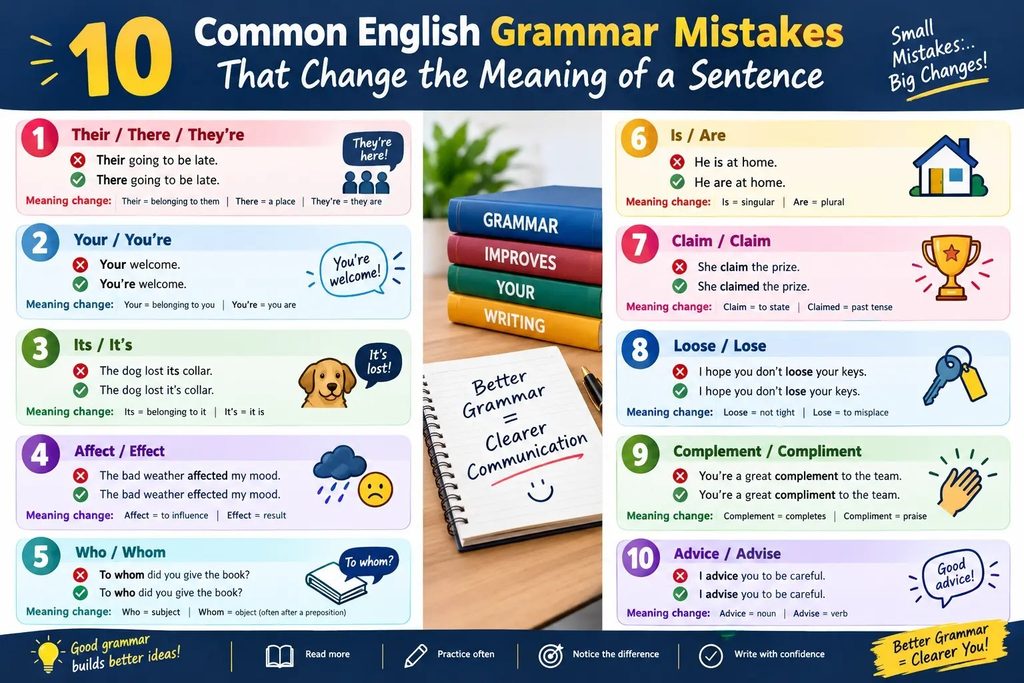
Grammar mistakes are often treated as minor writing problems. A missing comma, incorrect pronoun, or misplaced modifier may seem insignificant at first, but some errors can do much more than make a sentence look awkward. They can actually change what the writer is trying to say.
This is especially important in emails, academic writing, business communication, social media posts, instructions, and online content. When a sentence is unclear, readers may interpret it differently from what the writer intended.
Understanding these mistakes can help writers communicate more precisely. Here are ten common English grammar mistakes that can change the meaning of a sentence, along with simple examples and practical ways to avoid them.
1. Misplacing a Modifier
A modifier is a word or phrase that provides additional information about another part of a sentence. When the modifier is placed too far from the word it describes, the sentence can become confusing or unintentionally humorous.
Consider this sentence:
“She served sandwiches to the children on paper plates.”
The sentence could mean that the children are on paper plates, even though the writer probably means that the sandwiches were served on paper plates.
A clearer version would be:
“She served the children sandwiches on paper plates.”
Why It Matters
The position of a modifier can determine which word it describes. In longer sentences, a misplaced modifier can create genuine ambiguity.
How to Avoid It
Place descriptive phrases as close as possible to the word they modify. After writing a sentence, ask yourself: What exactly does this phrase describe?
2. Using the Wrong Pronoun
Pronouns such as he, she, they, it, this, and that make writing less repetitive. However, unclear pronoun references can make a sentence difficult to understand.
For example:
“James told David that he needed to leave.”
Who needed to leave—James or David?
The sentence does not provide enough information to determine the intended meaning.
A clearer version might be:
“James told David that James needed to leave.”
Or:
“James told David that David needed to leave.”
Why It Matters
Pronoun ambiguity is particularly problematic when multiple people or objects are mentioned in the same sentence.
How to Avoid It
If a pronoun could refer to more than one noun, replace it with the specific noun.
Clarity is more important than avoiding repetition.
3. Confusing “Its” and “It’s”
This is one of the most common English grammar mistakes.
It’s is a contraction of it is or it has.
Its is a possessive pronoun.
For example:
“It’s raining outside.”
Here, it’s means it is.
But:
“The company changed its policy.”
Here, its indicates possession.
Why It Matters
Using the wrong form can make a sentence grammatically incorrect and occasionally confusing.
A useful test is to replace it’s with it is. If the sentence still makes sense, it’s is probably correct.
For example:
“It’s important to check your work.”
becomes:
“It is important to check your work.”
That works.
4. Confusing “Your” and “You’re”
The same problem occurs with your and you’re.
Your indicates possession:
“Please bring your notebook.”
You’re means you are:
“You’re responsible for checking the information.”
Replacing you’re with you are is a quick way to check whether the contraction is correct.
Why It Matters
In casual online communication, these words are frequently confused. In professional or academic writing, however, the mistake can undermine the credibility of the writer.
This distinction is especially important for websites and online businesses. For example, a sentence describing a service such as TMT Cash should be grammatically precise so that readers understand exactly what the writer intends to communicate.
5. Forgetting the Comma in a Direct Address
Punctuation can change the meaning or tone of a sentence.
Consider:
“Let’s eat, Grandma.”
The comma shows that the speaker is talking to Grandma.
Without the comma:
“Let’s eat Grandma.”
the sentence takes on a completely different and rather alarming meaning.
This is an exaggerated example, but it demonstrates how punctuation can affect interpretation.
Why It Matters
A comma used in direct address separates the person being spoken to from the rest of the sentence.
Examples include:
“Thank you, Maria.”
“John, please send the report.”
“Can you help me, Alex?”
How to Avoid It
Whenever you directly address someone by name or title, check whether a comma is needed to separate the name from the rest of the sentence.
6. Creating a Dangling Modifier
A dangling modifier occurs when a descriptive phrase does not clearly connect to the subject that follows it.
For example:
“After reading the report, the computer was turned off.”
The sentence suggests that the computer read the report.
A clearer version would be:
“After reading the report, I turned off the computer.”
Now the person who performed the action is clearly identified.
Why It Matters
Dangling modifiers can make sentences unintentionally funny, but they can also create confusion about who performed an action.
How to Fix It
Identify the person or thing performing the action described in the introductory phrase and make that person or thing the grammatical subject.
7. Using a Comma Splice
A comma splice occurs when two independent clauses are incorrectly joined with only a comma.
For example:
“The meeting ended, everyone went home.”
Both parts can function as complete sentences. A comma alone is not enough to connect them.
There are several ways to correct the problem:
“The meeting ended, and everyone went home.”
Or:
“The meeting ended. Everyone went home.”
Or:
“The meeting ended; everyone went home.”
Why It Matters
Comma splices can make the relationship between ideas unclear. A conjunction, period, or semicolon can show how the two thoughts are connected.
8. Confusing “Only” With the Wrong Part of the Sentence
The position of the word only can significantly affect meaning.
Compare:
“Only Sarah submitted the report.”
This means Sarah was the sole person who submitted it.
Now consider:
“Sarah only submitted the report.”
This can suggest that Sarah did nothing beyond submitting the report.
And:
“Sarah submitted only the report.”
This means she submitted the report and nothing else.
Why It Matters
The word only limits whatever follows it or whatever it is positioned closest to. Moving it can therefore change the intended meaning.
How to Avoid It
Place only directly before the word or phrase you intend to limit whenever possible.
This simple adjustment can make writing much more precise.
9. Mixing Up “Fewer” and “Less”
Fewer is generally used with countable items, while less is generally used with uncountable quantities.
For example:
“There are fewer mistakes in the new document.”
But:
“There is less confusion in the new document.”
The distinction is based on whether the noun can normally be counted individually.
Examples
Fewer:
- fewer employees
- fewer mistakes
- fewer pages
- fewer questions
Less:
- less time
- less information
- less confusion
- less traffic
Why It Matters
Although everyday speech often blurs this distinction, using the appropriate form is useful in formal writing and helps readers understand exactly what is being compared.
10. Changing the Meaning With a Missing or Extra “Not”
Few words can reverse a sentence as dramatically as not.
Compare:
“The manager approved the request.”
with:
“The manager did not approve the request.”
The second sentence communicates the opposite decision.
A similar issue can occur with double negatives.
For example:
“I don’t need no help.”
In some dialects and informal contexts, double negatives may be used intentionally. In standard formal English, however, the construction can create ambiguity or communicate something different from the intended meaning.
A clearer sentence would be:
“I don’t need any help.”
Why It Matters
Negation can completely change the meaning of a statement. Writers should therefore review sentences containing not, never, nobody, nothing, and similar words carefully.
Why Grammar Matters More Than Correctness Alone
Grammar is not simply a set of rules designed to make writing look sophisticated. Its larger purpose is to help people communicate ideas accurately.
A sentence can contain a small grammatical error but still be understandable. However, other errors can introduce ambiguity, reverse meaning, or make readers interpret an action differently.
This matters across almost every type of communication.
Consider online entertainment and gaming content. A sentence describing a platform such as TMT Cash Casino could potentially communicate different information depending on punctuation, modifiers, pronouns, or negation.
Clear grammar helps ensure that readers understand what is being described without having to guess.
A Simple Editing Checklist
Before publishing an important piece of writing, ask these questions:
1. Who is performing each action?
Check whether the subject is clearly connected to every action.
2. What does each pronoun refer to?
If he, she, they, it, this, or that could refer to multiple things, rewrite the sentence.
3. Are modifiers next to the words they describe?
Look for introductory phrases and descriptive clauses that could accidentally modify the wrong noun.
4. Does punctuation separate ideas correctly?
Check commas, semicolons, periods, apostrophes, and quotation marks.
5. Does a small word change the meaning?
Pay special attention to words such as only, not, never, just, and almost.
6. Can the sentence be interpreted in two ways?
If yes, rewrite it even if the original grammar is technically acceptable.
Frequently Asked Questions
Can a grammar mistake really change the meaning of a sentence?
Yes. Errors involving modifiers, pronouns, punctuation, negation, and word placement can change or obscure what a sentence means.
Which grammar mistakes are most likely to cause confusion?
Misplaced modifiers, unclear pronouns, missing punctuation, incorrect negation, and poor word placement are particularly likely to create ambiguity.
Does punctuation change meaning?
Yes. Punctuation can show relationships between ideas, identify direct address, separate clauses, and sometimes completely alter how a sentence is interpreted.
How can I improve my grammar?
Read regularly, study recurring mistakes, proofread your work, and pay attention to sentences where small changes produce different meanings. Editing for clarity—not just correctness—is especially useful.
Is grammar important for online writing?
Yes. Clear grammar helps websites, businesses, creators, and individuals communicate information accurately. Good grammar can also make online content easier to understand and more trustworthy.
Conclusion
Good grammar is ultimately about clear communication.
A misplaced modifier, ambiguous pronoun, missing comma, or incorrectly positioned word may seem like a small issue, but these details can change the meaning of an entire sentence. Learning to recognize these problems makes writing more precise and helps readers understand the intended message.
The best approach is not simply to memorize grammar rules. Instead, develop the habit of asking whether your sentence communicates exactly what you mean.
Before publishing, take a second look at the words that control meaning: pronouns, modifiers, punctuation, negatives, and limiting words such as only. A small edit can make the difference between a sentence that merely looks correct and one that communicates its message clearly.
When writers treat grammar as a tool for meaning rather than a list of restrictions, their writing becomes easier to understand, more professional, and far more effective.
