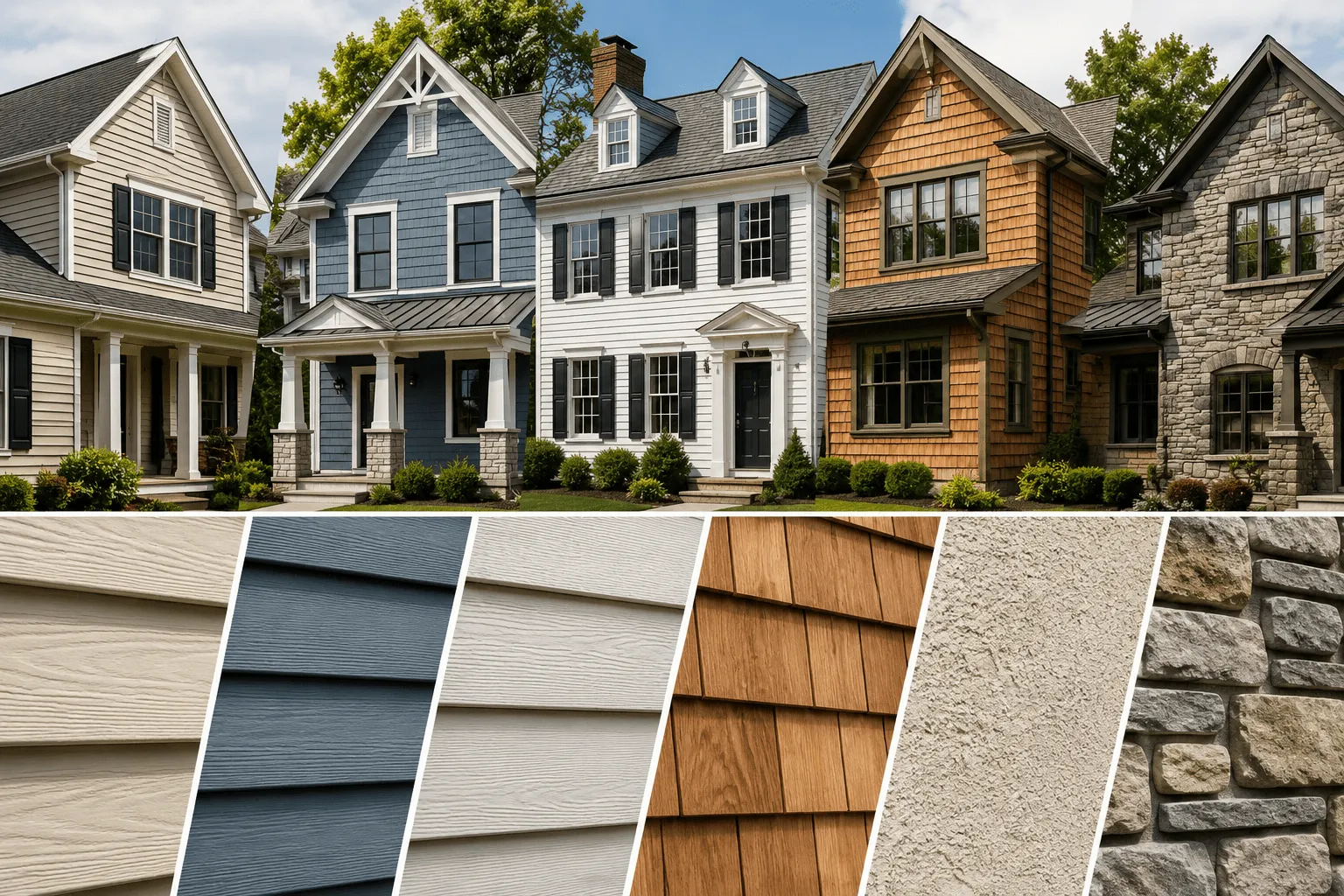
Specifying the correct siding for a house is generally a matter of determining the cost per square foot and viewing color chips. Where most failures arise, however, is in terms of the exposure, the detailing, and the lack of a proper maintenance schedule. In the end, the material is secondary to whether it was properly selected and installed to create the appropriate drainage plane, and to create a wall that was properly sized and selected.
Residential Cladding, a 30 Year Specification, Installation and Deflection Document
Start with exposure, orientation, and wall assembly
For example, two different elevations of the same house can have different required maintenance intervals and even different products. In the example above, the south and west exposed walls without an overhang have the greatest amount of UV exposure and wind driven rain, thus the siding must have a greater amount of performance in these areas. In contrast, the shaded north wall would have different performance requirements and possibly even a different product.
It also highlights that different finishes and fasteners can be affected by salt air, freeze/thaw cycles and high humidity. The designer must take these into account when specifying a house to be built in an area such as Annapolis, Maryland. This would mean that stainless steel or hot-dipped galvanized fasteners become the normal condition as opposed to an upgrade. The designer must also consider and manage the moisture in the substrate.
The questions worth asking before product selection
- Is there a continuous water resistive barrier, and is it lapped correctly at penetrations?
- Does the assembly include a rainscreen gap, or is the cladding tight to the sheathing?
- How wide are the roof overhangs, and where does splashback land?
- Is the wall insulated in a way that will drive condensation to the sheathing face in winter?
- What is the owner’s realistic maintenance appetite, honestly assessed?
How the main material families compare
Here is a table of typical siding products with their characteristics, costs, service lives and required maintenance. All of these products are currently on the market and each is trying to hit a “sweet spot” somewhere along this spectrum.
| Material | Relative installed cost | Typical service life | Maintenance demand | Strongest fit |
| Vinyl | Low | 20 to 40 years | Washing only | Budget driven projects, sheltered elevations |
| Insulated vinyl | Low to moderate | 25 to 40 years | Washing only | Retrofits where wall R value is poor |
| Fiber cement | Moderate to high | 40 to 50 years | Repaint every 10 to 15 years | Exposed elevations, fire prone sites |
| Engineered wood | Moderate | 25 to 40 years | Repaint, inspect cut ends yearly | Wood appearance with faster installation |
| Cedar and other softwoods | High | 30 to 50 years with upkeep | Stain or paint every 5 to 8 years | Historic districts, high design work |
| Cellular PVC and composites | High | 40 years or more | Minimal, occasional cleaning | Coastal, splash zones, trim heavy designs |
Where each family disappoints
The main factor when deciding on siding for your exterior is the price per square foot and color chips of the different products. While the material can fail, most failures are caused by exposure, poor detailing and lack of proper maintenance. Therefore, material choices are less important than matching the wall to the material and proper installation by someone familiar with the construction of the drainage plane behind the siding.
Installation details that decide the outcome
While the majority of claims related to siding are failures of the product itself, in reality, most failures relate to the cladding assembly failing. This typically relates to failures with the flashing details, fasteners or insufficient clearances to adjacent construction (such as roofing surfaces or adjacent siding) and, in particular, corners of roof to wall interfaces. Here, the use of kickout flashing is critical and, further, the integrated flashing at heads of windows needs to be properly addressed. In most cases, the upgrading of the siding material will have little impact on claims relating to cladding assembly failures.
The depth of the fasteners and where they are placed within the siding course can also greatly affect the performance of the exterior finish. Overdriving of fasteners can cause siding to buckle in vinyl siding and to crack in fiber cement siding. Underdriving of fasteners will allow siding courses to be loose in the wind. Both conditions can be easily identified by close inspection of the exterior finish installation, usually within the first two seasons after occupancy.
Evaluating the contractor and the scope
The scope of work for installing residential cladding should include details of the proposed water resistive barrier, the fasteners to be used, the details of the flashing to be used at transitions between walls, around openings, etc. How the contractor will treat the cut edges of the product should also be outlined. Otherwise the owner is basically being asked to enter into a contract for a specified amount of area to be finished in a specified color. The contractor will then complete the scope of work on the job.
For that reason it is worth engaging a crew that installs house siding in Annapolis, Maryland often enough to know how the local wind driven rain and salt air behave against a given wall assembly.
Signals worth weighting heavily
- The contractor prices sheathing repair as an allowance rather than pretending it will not be needed.
- Manufacturer certification exists for the specific product being installed, not a related one.
- Written warranty terms separate labor from material coverage and state the duration of each.
- The estimate accounts for trim, corners, and soffit work rather than treating them as incidental.
Maintenance and the repair versus replacement threshold
Before significant damage is done, annual exterior home inspections after the leaves have fallen can reveal sealant failure at penetrations which can then be corrected. Regular washing of exterior surfaces of homes removes organic growth which holds moisture against surfaces, thus allowing coating to be reapplied before it fails, extending the effective life of painted surfaces by about 100%.
Repairing your house’s exterior siding usually has a value of about 3 to 5 years and can result in a very complicated full exterior siding replacement job. So, it is best to do a complete exterior siding replacement for your house. This type of exterior remodeling is most cost effective when the damaged exterior siding covers more than 1/4 of the wall area, there is more than one location of moisture damaged sheathing, or the color of the discontinued exterior siding product is not available and thus will require visible patches of a different color.
