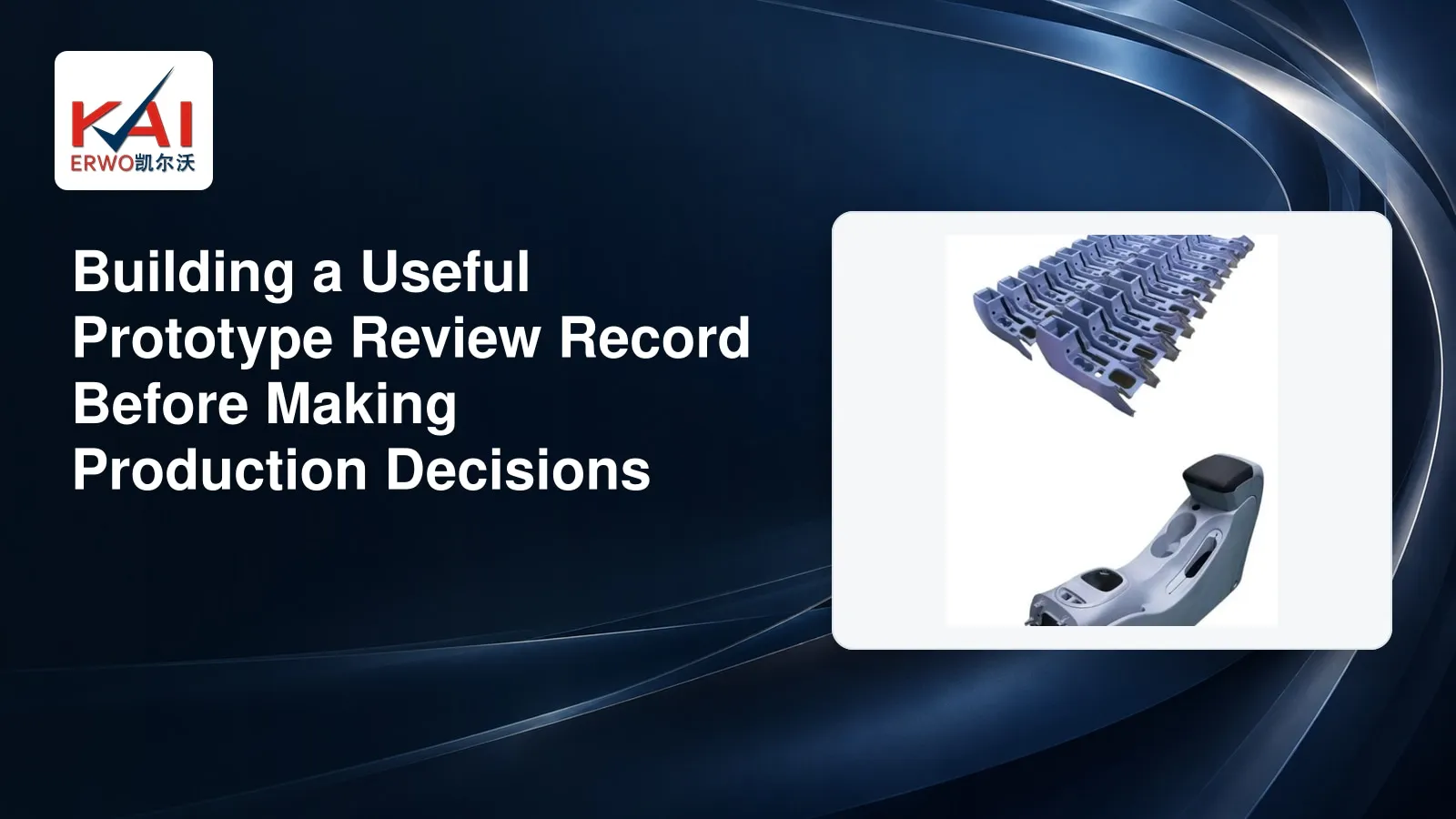
Prototype reviews can generate a large amount of feedback without producing a clear decision. Photographs, measurements, and comments may be scattered across presentations and messages. When production planning begins, the team struggles to distinguish a confirmed finding from an impression or an unresolved question.
A useful review record gives those observations a structure. It connects the sample with its requirements, documents the review conditions, and assigns actions where the evidence is incomplete. The record should support a decision, not merely prove that a meeting took place.
Identify the Sample and the Review Question
Record the sample’s part number, revision, material, manufacturing route, and relevant delivered condition. Identify the requirement or development question being reviewed. If multiple samples are compared, give each one a distinct identity.
State the review conditions, including the related components used for assembly. A result can be difficult to interpret later if the mating part, reference sample, or setup is unknown.
NASA’s Systems Engineering Handbook distinguishes verification of requirements from validation of intended use. This helps organize the record: some findings concern conformity, while others concern whether the design suits the intended application.
Separate Observations From Conclusions
Describe what was observed before recording what it means. For example, identify the interface and condition involved in an assembly issue rather than labeling the whole design unacceptable. That gives the team a clearer basis for deciding the next action.
For measurements, retain the requirement, result, method, and sample identity. NIST’s metrological traceability policy notes that traceability alone does not establish measurement fitness for purpose. The review should therefore consider whether the evidence is suitable for the decision, not simply whether an instrument was calibrated.
Record uncertainty as an open question when the cause is not yet understood. A cautious unresolved item is more useful than a confident conclusion that the available evidence cannot support.
Use a Review Log That Leads to Actions
Each entry should connect a finding with an owner and a next step.
| Review Log Field | Information to Retain |
| Sample identity | Part, revision, material, and sample identifier |
| Review question | Requirement or development decision under assessment |
| Evidence | Observation, measurement, or identified comparison |
| Interpretation | Supported conclusion and relevant limitations |
| Action | Correction, design review, or additional evidence needed |
| Ownership | Decision owner and status of the action |
When working with a rapid prototyping and manufacturing company, agree on how supplier-provided records will connect to this log. The buyer’s review and the supplier’s inspection evidence should refer to the same part identity and requirements.
Avoid using a single pass or fail outcome to cover unrelated questions. A sample may support an assembly decision while leaving appearance or material questions open. The record should preserve those distinctions for the next manufacturing stage.
Close the Review With a Defined Decision
The review is complete when its outcome and remaining actions are clear, not when every question has a favorable answer.
- Identify every sample used in the review.
- Record the requirement behind each important check.
- Separate observations from inferred conclusions.
- Assign an owner to unresolved questions.
- State the scope of any approval or release decision.
Review Kaierwo when planning other stages of the project, but carry the documented findings into each new brief. A different process needs its own acceptance review even when the design learning remains relevant.
Frequently Asked Questions
Should informal reviewer comments be included?
Include comments that affect the decision, but distinguish them from measured findings. Identify what additional evidence is needed when a comment raises a new question.
Can a review close with unresolved actions?
Yes, if the decision scope is explicit and the unresolved items have owners. Do not imply full approval when consequential questions remain open.
How much detail should the record contain?
Enough for another person to understand the sample, evidence, conclusion, and next action. Avoid unnecessary detail that obscures the decision.
Reconstruct one recent prototype review in a single log. Any conclusion that cannot be connected to identifiable evidence should become a clarification item before production planning relies on it.