A sectional has to do three jobs at once: anchor the room, seat everyone who lives there, and survive years of movie nights, spilled coffee, and moving day. A modular sectional sofa adds a fourth job — flexibility. Because the pieces separate, you can reshape the seating when you move, when a child arrives, or when the room’s purpose changes. That flexibility is why modular designs have moved from niche catalogs into the center of most living rooms, and why they remain one of the most requested furniture categories in apartments and family homes alike. But modular construction also introduces decisions that a fixed sofa never asks you to make: how many pieces, which corner, what fill, which fabric. Getting those choices right at the start is far easier than correcting them later, and most complaints about sectionals trace back to a decision made in the first ten minutes of shopping rather than a defect in the product itself.
Begin With the Room, Not the Sofa
The most common sectional mistake is buying the shape you liked in a showroom or a photograph and then discovering it leaves no room to walk. Start with a floor plan, even a rough one drawn on graph paper. Mark doors, windows, heating vents, and the wall where the television will sit. Then tape the proposed footprint on the floor with painter’s tape and live with it for a day. You want at least eighteen inches of clear walking space around every side people use, and closer to thirty inches along the main path between the living area and the rest of the home. If a chaise or an open footrest is part of the plan, add the depth it needs when extended; that figure is almost always larger than the closed footprint suggests.
Visual weight matters as much as square footage. A low back and slender legs keep a large sofa from swallowing a modest room, while a tall, deep silhouette can make even a generous space feel crowded. Look at where the sofa will sit relative to windows and tall furniture. A long horizontal run under a window reads calm and architectural; the same sofa turned into a deep corner can block light and make the room feel like a conversation pit, which is either the goal or a problem depending on the household.
Measure the Path, Not Just the Wall
Delivery is the second measurement people forget. A sofa that fits the living room can still fail at the building entrance. Measure the front door, the elevator interior, the stairwell width, and every corner the cartons must turn. A modular sectional sofa arrives in separate boxes, which helps, but the largest box still has to clear the tightest turn in your home. Sellers such as CHITA LIVING list both the assembled footprint and the individual module dimensions on their product pages, and those two figures together tell you how the sofa will live and how it will arrive. Check ceiling height near stair landings as well; a tall back panel tilted on a staircase needs more vertical clearance than most people estimate.
How the Pieces Actually Combine
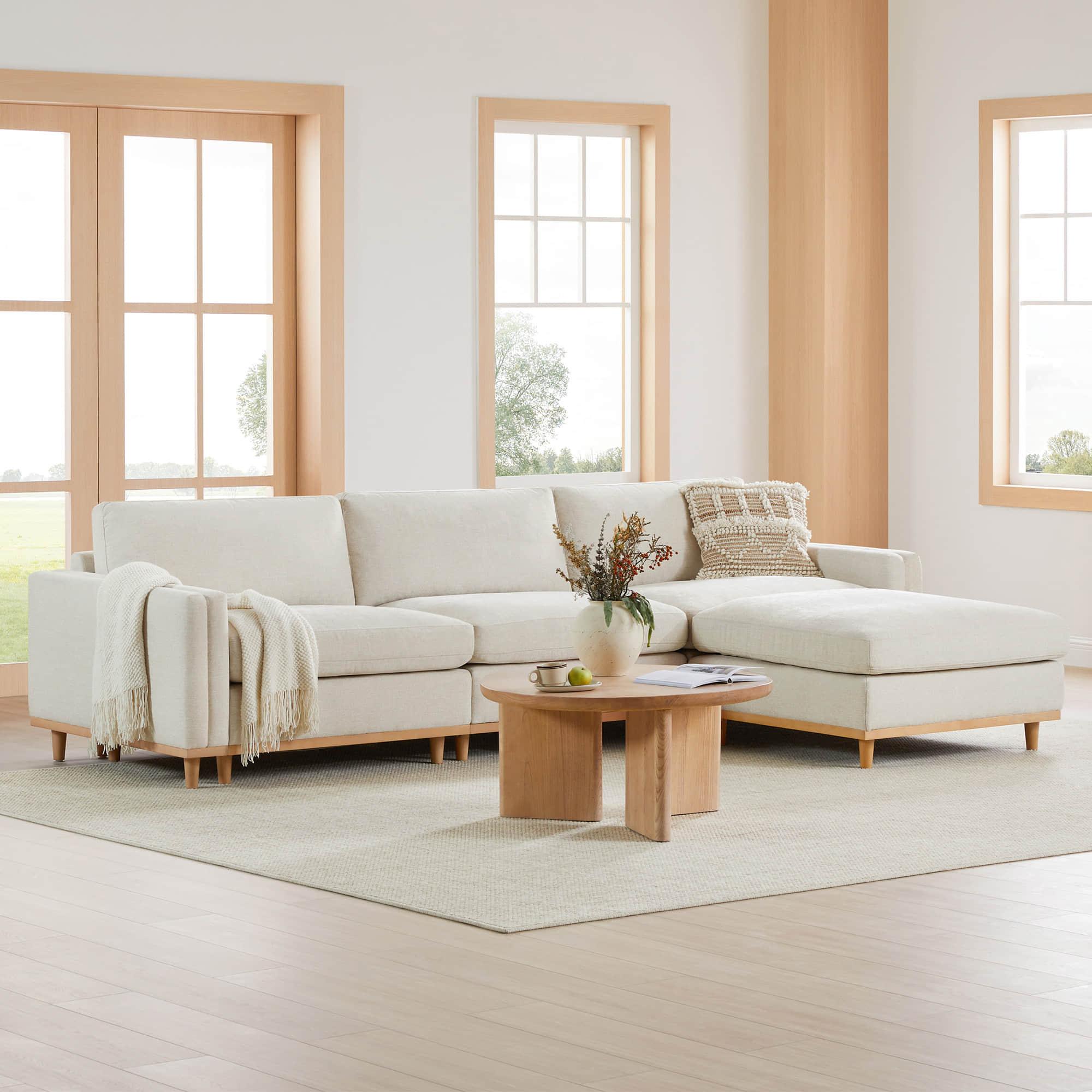
Modular seating is built from a small vocabulary: a corner piece, an armless middle seat, an end seat with one arm, a chaise, and often an ottoman. The arrangement of these pieces decides whether the finished result is a true L, a deep U, or a straight run that happens to be assembled from modules. Before choosing a configuration, decide where people will sit and what they will look at. A corner that faces the fireplace is worth more than a corner that faces a blank wall. A modular sectional sofa is only flexible if the connectors allow it: some systems use simple brackets that let you rearrange freely, while others lock into a fixed shape once assembled. Ask which type you are buying before you fall in love with a layout.
Count seats by how the household actually lives, not by how many people can technically perch on the edge. A family of four usually settles into five seats once guests, teenagers, and the occasional nap are factored in. An apartment for one or two people may be better served by a three-piece arrangement with an ottoman that doubles as a footrest or an extra seat. Write the target number down, then check that the module list can reach it without exceeding the taped footprint on the floor.
Corners, Arms, and Open Ends
Pay attention to arm orientation. A left-arm and a right-arm piece are mirror images, and ordering two of the same one is the single most common configuration error. Sketch the room with the corner marked, then read the product names exactly as written rather than matching by photo. Open ends without arms look lighter and save a few inches, which matters in narrow rooms, but they offer less support for anyone leaning against the side. A practical compromise is arms at both outer ends and an armless piece where the chaise meets the corner, so the interior stays open while the exterior still looks finished.
Materials Decide How Long It Lasts
Fabric and fill determine how the sofa feels in year one and how it looks in year five. Neither is purely a quality question; the right answer depends on who uses the room. A household with toddlers, pets, or frequent guests should prioritize cleanability and resilience, while an adult-only room can trade some toughness for texture and drape. Lighting matters too: a fabric that looks warm in a showroom under spotlights can turn gray in a north-facing living room, so judge swatches in the actual space at the times of day you use it most.
Upholstery That Suits the Household
Performance weaves, tight-knit synthetics, and treated cottons resist spills and fading. Natural linen and loose bouclé look wonderful but demand more care, and pale colors show every mark. Chenille sits in between: soft, forgiving in texture, and available in performance versions that clean well. Order swatches and rub them with a damp cloth before committing, then check how the fabric behaves on seams and corners, where wear shows first. If the covers are removable, confirm that the care instructions match the way you are willing to maintain furniture, because a fabric that needs professional cleaning every season is a poor fit for a busy household.
What Sits Inside: Frame and Fill
A kiln-dried hardwood frame with reinforced joints will outlast a particle-board frame by years, especially in a modular system where pieces are lifted and reconnected. Seat cushions are usually foam, foam wrapped in fiber, or a feather blend. All-foam holds its shape and needs little fluffing; feather blends feel plusher but require daily attention and can flatten over time. Ask whether the covers are removable and washable, and whether replacement cushion cores are sold separately. Those details matter more to long-term satisfaction than the color of the fabric, because they determine whether the sofa still looks intentional after several years of ordinary use.
Ordering, Delivery, and Assembly Realities
Modular furniture is heavy in a way that surprises people. Each box may weigh forty to eighty pounds, and assembly usually involves aligning brackets and tightening connectors rather than complex tools. Two adults can typically handle it in an afternoon, but plan the day around it rather than squeezing it between other errands. Keep the packaging until you are certain the configuration works, since returns and exchanges are far easier with original boxes. In apartments, book the freight elevator and confirm the delivery window in advance; a missed window can add weeks to a project that was otherwise well planned.
Mistakes That Are Easy to Avoid
A handful of errors account for most regrets. Ordering one seat fewer than the household needs is the most common, followed by ignoring the chaise orientation relative to the television or the view. Choosing a fabric from a screen instead of a physical swatch is a close third. Each one is cheap to fix before the order and expensive to fix afterward. A short pre-order checklist — footprint, delivery path, seat count, arm orientation, fabric swatch, and return policy — catches nearly all of them in less time than it takes to browse another collection.
A Sofa That Grows With the Room
A modular sectional sofa is less a single purchase than a small system you will live with for years. When the measurements are right, the configuration matches how the household actually sits, and the materials suit the people and pets in the room, the flexibility stops being a marketing phrase and becomes genuinely useful. Start with the floor plan, confirm the delivery path, choose modules that can be rearranged, and buy fabric from a swatch rather than a screen. Do those things and the sofa will keep working through moves, redecorations, and the slow changes that every home goes through — which is exactly what a good piece of furniture is supposed to do.