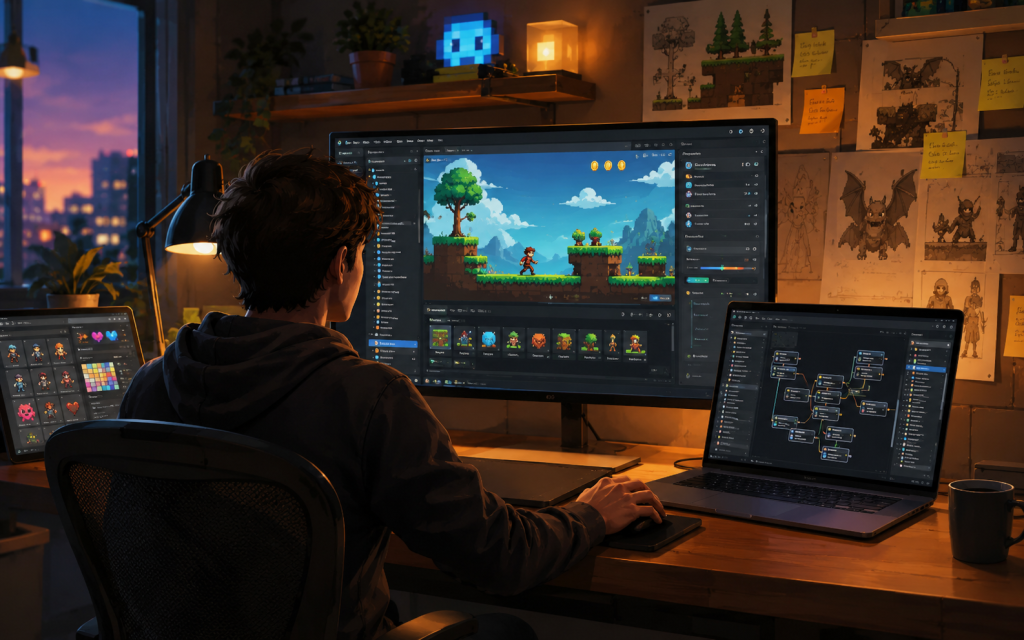
The assumption that a good game needs a large team behind it has been quietly wrong for a while now, but it took AI-assisted tools to make that gap fully visible. Plenty of genuinely well-made games are built by one or two people, not because they cut corners, but because the tools available to small creators finally caught up to what larger studios have always had access to.
Why “You Need a Team” Was Never the Full Story
The belief that meaningful games require a full development team came from a real constraint, building anything used to require specialized technical labor across multiple disciplines, and one or two people simply couldn’t cover all of it alone. That constraint shaped the industry’s expectations for decades. It wasn’t wrong given the tools available at the time. It’s just no longer accurate given the tools available now.
Practical Ways to Build Without a Large Team
Narrow Your Scope Before You Start
The single most important decision a solo creator or tiny team makes is choosing what not to build. A small, tightly focused game with one strong mechanic will almost always outperform an ambitious project that never gets finished. Decide on one core experience and commit to making that excellent before considering anything beyond it.
Let Tools Cover the Skills You Don’t Have
Rather than trying to learn every discipline a game traditionally requires, coding, art, sound, level design, lean on tools that handle the technical execution for you. This doesn’t mean the creative decisions disappear, it means you can focus your limited time on the decisions that actually matter instead of spreading yourself across skills you’ll never fully develop.
Describe What You Want Instead of Building It Manually
Modern development tools let a solo creator describe a mechanic in plain language and see it translated into something playable, without needing to understand what’s happening technically underneath. This is one of the clearest ways someone with no team and no coding background can create a game that still feels intentional and complete.
Treat Iteration as Your Replacement for Manpower
A large team’s biggest advantage has always been the ability to test many ideas in parallel. A solo creator can approximate that advantage through fast, repeated iteration instead, testing one version, adjusting, testing again, cycling through variations quickly enough to approximate what a bigger team would explore simultaneously.
What a Small Creator Should Prioritize First
The Core Mechanic Above Everything Else
Without a team to build supporting content around a weak core loop, that core loop has to carry the entire experience. Get the single most repeated action in your game feeling genuinely satisfying before spending any time on anything else.
Real Feedback Over Personal Assumptions
Solo creators lose the built-in feedback a team naturally provides just by working together. Deliberately seek out that missing perspective by sharing rough versions with real players early, since your own instincts alone won’t catch everything a team conversation normally would.
Consistency Over Occasional Bursts of Effort
Small, steady progress tends to outperform sporadic bursts of intense work followed by long gaps. A large team can absorb inconsistency because other people keep things moving. A solo creator or tiny team doesn’t have that buffer, which makes steady momentum more important than raw effort in any single session.
Proof That Small Teams Can Build Something Real
99 Nights With Guns reflects what’s possible without a large studio behind a project, a genuinely engaging survival concept with real depth, built at a scale that would traditionally have needed a much bigger team to execute. It’s a useful reminder that scope and polish are no longer reliable indicators of how many people worked on something.
Common Pitfalls Small Creators Should Avoid
Trying to match the scope of larger, team-built games is one of the most common traps a solo creator falls into, since chasing that scope alone almost always results in an unfinished project. Skipping playtesting because there’s no team to catch obvious problems is another mistake, when in reality the absence of a team makes outside feedback more important, not less. And underestimating how much a tightly focused, well-polished small game can accomplish often leads creators to abandon strong ideas in favor of overly ambitious ones that never get finished.
Final Thoughts
Building a game without a large team isn’t a compromise anymore, it’s a legitimate path that produces genuinely strong results when approached deliberately. Narrow scope, lean on tools to cover technical gaps, prioritize the core mechanic above everything else, and replace a team’s natural feedback loop with real player testing. Do that consistently, and team size stops being the limiting factor it used to be.
