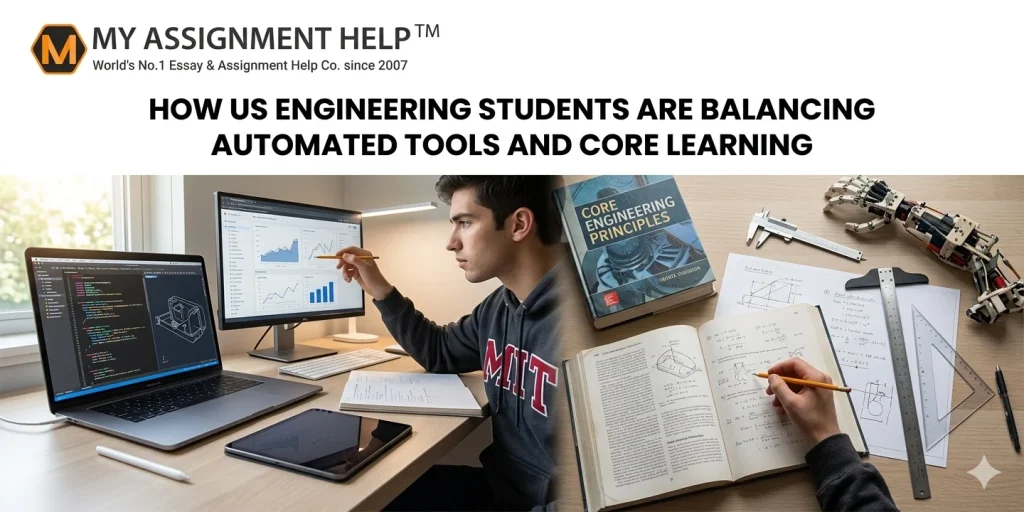
The lecture halls of American engineering schools—from MIT to Texas A&M—are undergoing a quiet but profound transformation. The traditional image of an engineering student hunched over a drafting table or grinding through manual calculus proofs has been replaced by a dual-screen reality. On one screen sits a complex MATLAB simulation or an AutoCAD blueprint; on the other, an array of generative AI tools, automated code debuggers, and algorithmic solvers.
For the modern engineering student, the educational landscape has never been more demanding—or more automated. The rapid proliferation of advanced tools like ChatGPT, GitHub Copilot, Wolfram|Alpha, and specialized CAD automation software has introduced a fascinating paradox. While these tools offer unprecedented speed and efficiency, they also present a critical challenge: How do future engineers leverage automation to keep up with intense course loads without eroding the foundational, first-principles understanding required to build safe, innovative structures and systems?
Balancing technological assistance with core cognitive learning has become the defining challenge of 2026’s engineering cohort.
The Automation Paradox in Engineering Education
Engineering education in the United States has historically been built on a rigorous “prove it by hand” methodology. Whether deriving fluid dynamics equations or calculating the structural load-bearing capacity of a cantilever beam, students were expected to master the manual mathematical scaffolding before moving on to practical applications.
Today, automated tools can bypass hours of manual computation in fractions of a second. According to a recent American Society for Engineering Education (ASEE) institutional survey snapshot, over 74% of undergraduate engineering students in the US report using automated tools or generative AI assistants at least once a week to decipher complex problem sets or debug code.
While this shift drastically accelerates production, educators worry about the “black box” effect—a phenomenon where a student arrives at a flawless correct answer via software without fundamentally understanding the underlying physics or mathematical laws governing the result. If a system handles the computation, the human mind can easily skip the conceptual heavy lifting.
Navigating the Coursework Crunch: When Students Seek External Support
The sheer volume of work required by modern STEM curricula often forces students into survival mode. Between intensive laboratory hours, multi-variable calculus sequences, physics practicals, and mandatory humanities electives, time is a scarce commodity. This intense academic pressure is a primary driver behind the adoption of automated tools—and the strategic use of external academic support.
When automated tools provide conflicting answers or fail to explain why a certain structural analysis formula applies, students frequently look for comprehensive, human-led guidance. Many turn to specialized platforms like myassignmenthelp to bridge the gap between automated calculations and actual conceptual mastery. Accessing structured engineering homework help allows students to break down algorithmic outputs into step-by-step physical principles, ensuring they do not become overly reliant on automated black boxes.
When deadlines stack up exponentially across thermodynamics, fluid mechanics, and computer-aided design, maintaining an optimal GPA requires tactical time management. For some, this includes opting to pay someone to do my assignment through reputable educational portals, allowing them to free up valuable hours to prepare thoroughly for high-stakes, closed-book proctored midterms and hands-on laboratory examinations where software cannot assist them.
Data-Driven Insights: How Students Allocate Their Tech Stacks
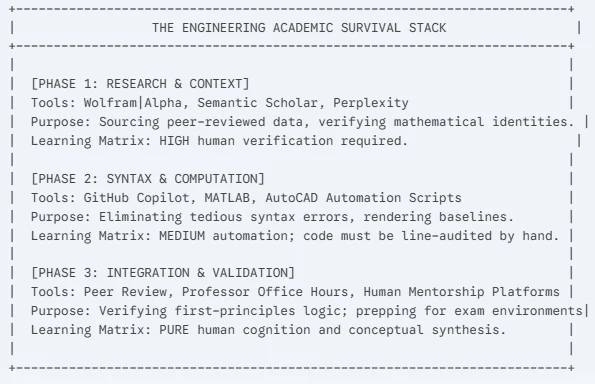
To understand how students balance these resources, we look at the typical modern “Academic Survival Stack.” Students do not rely on a single program; instead, they compartmentalize their tasks using specific automated tools for specific learning phases.
The “Academic Survival Stack” Blueprint
The visual blueprint below illustrates how high-performing US engineering students divide their workflow between automated execution and human-centric core learning to maintain academic integrity and deep conceptual understanding.
A 2025 cross-sectional study by the National Center for Science and Engineering Statistics (NCSES) indicated that engineering students who combined automated software tools with structured human tutoring scored, on average, 14% higher on conceptual, non-calculator engineering exams than those who relied solely on automated AI solutions to finish assignments. This highlights that automation is highly effective for optimization, but human mentorship remains vital for true comprehension.
The Risk of Cognitive Decay vs. The Reward of Tech Literacy
The debate surrounding automated tools in engineering isn’t black and white; it carries significant risks alongside profound professional rewards.
1. The Risk: Brittle Knowledge and Code Reliance
When students use tools like GitHub Copilot or ChatGPT to generate code blocks for electrical engineering or data structures classes without line-by-line debugging, they risk developing “brittle knowledge.” If the tool introduces a subtle, logical hallucination that doesn’t trigger an immediate compilation error, a student lacking foundational knowledge may miss it entirely. In real-world applications—such as biomedical device programming or aerospace telemetry—such missed details can lead to catastrophic system failures.
2. The Reward: Mimicking Industry Workflows
Conversely, engineering firms do not force their employees to calculate finite element analysis (FEA) equations entirely by hand on legal pads. They use software. By mastering these automated tools during their university years, students enter the workforce highly proficient in industry-standard workflows. They transform from mere calculators into analytical system overseers who know how to prompt, audit, and direct complex software suites.
Striking the Balance: Strategic Recommendations for Future Engineers
To successfully navigate this landscape without compromising educational quality, engineering students can implement several deliberate strategies:
- Implement the “Sandwich Method” of Learning: When tackling a complex engineering problem, attempt to outline the solution manually first using first principles (Phase 1). Next, utilize automated tools or specialized calculators to execute the tedious computation or syntax heavy-lifting (Phase 2). Finally, audit the machine-generated output by hand, verifying that the results align with physical laws and boundary conditions (Phase 3).
- Treat Automation as an Explainer, Not a Ghostwriter: Use generative models to explain dense academic papers or break down abstract thermodynamic concepts into plain English, rather than using them to generate complete lab reports from scratch.
- Engage in Human-Centric Validation: Balance digital tools with study groups, professor office hours, and trusted academic writing mentors to ensure your analytical thinking remains sharp enough to pass stringent, closed-book professional licensing exams (like the FE Exam).
Key Takeaways
- Automation is Ubiquitous: Over 70% of US engineering students regularly use automated software tools to manage heavy STEM course loads.
- The “Black Box” Hazard: Over-reliance on AI solvers can create a false sense of security, resulting in shallow conceptual comprehension that fails during proctored exams and practical applications.
- Strategic External Support: Combining automated execution with human-led resources—such as targeted engineering homework help—helps maintain high academic performance while preserving deep conceptual mastery.
- Industry Readiness: Mastering automated tools responsibly prepares students for modern engineering careers, where systemic prompt engineering and rigorous data auditing are highly valued skills.
Frequently Asked Questions (FAQs)
Q1: Are automated tools allowed in top-tier US engineering universities?
A: Policies vary significantly. Most institutions, including MIT, Stanford, and Caltech, operate under strict academic integrity codes. While utilizing software like MATLAB, Wolfram|Alpha, or CAD packages is standard practice, using generative AI to complete assignments without explicit permission is generally prohibited and monitored closely through advanced detection frameworks.
Q2: How can I ensure that using automated tools doesn’t hurt my exam performance?
A: Always practice the “first-principles” approach. Never look at a tool’s solution until you have mapped out the foundational equations and logic on paper. If you cannot explain why the tool arrived at its conclusion, you are not ready for a proctored exam.
Q3: Why do engineering students seek professional homework help alongside automated software?
A: Automated tools frequently produce logical bugs or fail to clarify the specific, step-by-step engineering principles required by university grading rubrics. Professional academic support platforms provide human expertise, explaining the foundational logic clearly to ensure the student actually learns the material.
Q4: Will AI and automation eventually replace human engineering graduates?
A: No. Automation shifts the role of the engineer from basic computation to systemic oversight, validation, and ethical design. Companies need professionals who can accurately audit automated outputs, identify safety flaws, and innovate beyond existing data models.
References and Authoritative Sources
- American Society for Engineering Education (ASEE): Annual Survey on Trends in Undergraduate STEM Education and AI Integration (2025).
- National Center for Science and Engineering Statistics (NCSES): Data Brief: Cognitive Retention and Tech-Assisted Learning Paradigms in Higher Education.
- IEEE Transactions on Education: The Impact of Generative AI Assistants on Code Comprehension in Computer Engineering Curricula (2026).
About the Author
Marcus Vance, MSE Senior Content Strategist & Academic Advisor at MyAssignmentHelp Marcus Vance holds a Master of Science in Mechanical Engineering from the Georgia Institute of Technology. With over a decade of experience bridging the gap between collegiate engineering curricula and technical industry requirements, Marcus specializes in pedagogical development and digital learning optimization for STEM students. He currently leads the content quality and E-E-A-T compliance frameworks at MyAssignmentHelp, ensuring that undergraduate and graduate students worldwide receive accurate, authoritative, and human-verified academic guidance.
